When a CSR manager has to choose between two NGOs doing similar work, the decision almost never comes down to who does better work on the ground. It comes down to who they can trust with less effort. The PATVAAR Trust Score exists to make that trust measurable, comparable, and verifiable — so good work is no longer invisible to the people who fund it. This guide explains exactly what the score measures, how it is computed across five weighted pillars, and how to improve yours.
For years, the credibility of an NGO in India has been something funders had to take on faith or establish through weeks of manual due diligence. The result is a system where funding tends to go to the organisations that are easiest to verify, not necessarily to the ones that are most effective. The Trust Score is designed to change that by giving every organisation a way to prove its credibility on the same terms.
What Is the PATVAAR Trust Score?
The PATVAAR Trust Score is a standardised, document-reviewed credibility score for NGOs. It is a single number from 0 to 100, computed from verified documents across five weighted pillars. It is not a survey, and it is not self-reported. Every input is reviewed against a source document before it counts toward the score, and official-portal checks are recorded where performed.
The distinction between verified data and self-reported claims is the entire point. Any NGO can write an impressive profile describing its impact, governance, and financial discipline. The Trust Score does not take any of that at face value. It checks whether the registration is real and current, whether the tax exemptions are valid, whether the audits were genuinely signed off, and whether the organisation operates the governance structures it claims. What survives that checking becomes the score.
The methodology is public. The weights, the tier thresholds and the hard-fail triggers are all published, and every published profile shows the pillar-by-pillar breakdown. Paid plans don’t change your Trust Score or verification, and there is no way to pay for a higher number. This openness is deliberate — a credibility score that cannot itself be trusted is worthless.
Why a Trust Score Matters More Than a Good Proposal
A well-written proposal can get you noticed. It cannot, on its own, get you funded. A proposal is something you produce about yourself, and every funder knows it. The most polished proposal in the world is still a claim until someone verifies the organisation behind it.
This is where most credible NGOs lose out. They write strong proposals and do genuinely good work, but when the CSR team begins due diligence, the process stalls. Documents take days to arrive. Some are outdated. The financial picture is unclear. Each small friction adds risk in the funder's mind, and risk is the one thing CSR managers are paid to avoid. Eventually they fund the organisation that was easier to verify, even if its work was no better.
A Trust Score removes that friction before it begins. When your credibility is already backed by documented evidence and visible, the funder's due diligence is largely done before they contact you. You move from being a claim that needs checking to being a verified entity they can act on. In a funding environment where the difference between getting funded and getting passed over is often just the level of perceived risk, that shift is decisive. To understand exactly what funders examine, read our guide on the NGO due diligence checklist CSR teams use.
The Five Weighted Pillars
A meaningful score cannot rest on a single factor. An NGO might have perfect tax compliance but weak governance, or strong governance but opaque finances. To capture the full picture, the Trust Score is built across five distinct pillars, each carrying a defined weight and each checked against source documents.
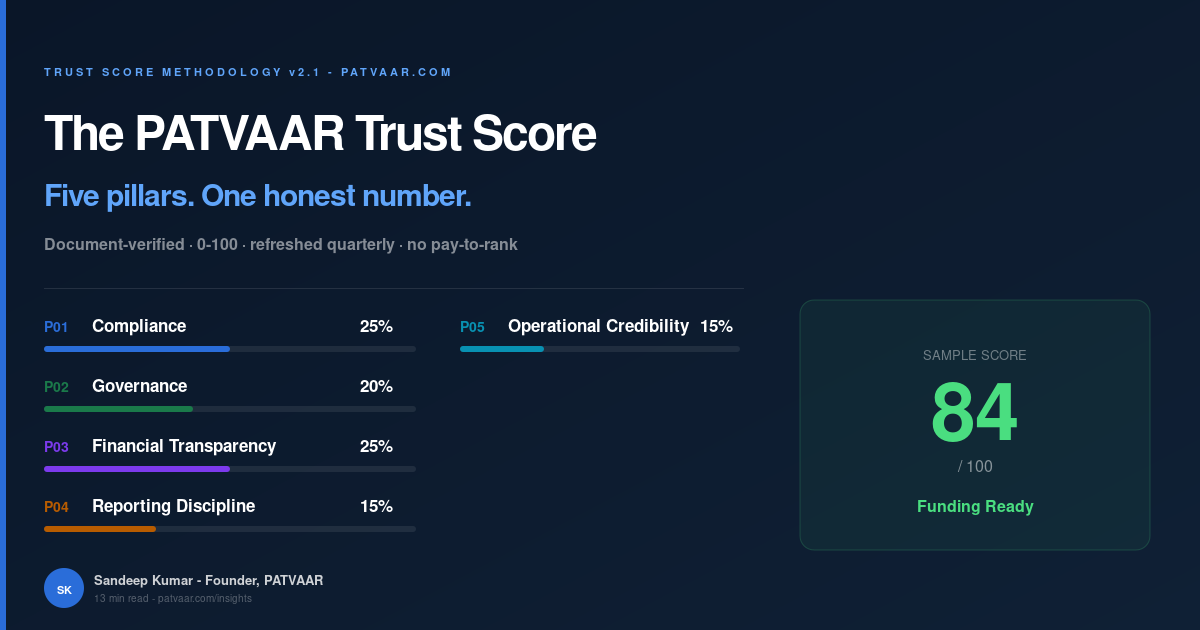
The weights are deliberate. Compliance and Financial Transparency carry the most weight, at 25% each, because they are the areas where funders face the greatest legal and reputational risk. Governance follows at 20%. Reporting Discipline and Operational Credibility each carry 15% — important, but secondary to the legal and financial foundations. Together they sum to a single honest number out of 100.
The value of separating these five pillars is that it shows a funder not just how trustworthy an organisation is overall, but exactly where its strengths and gaps lie. An organisation strong on compliance and finances but thin on operational track record is a different proposition from one with deep field credibility but governance gaps. The pillar breakdown lets funders make that judgment — and lets you see precisely what to improve.
How the Score Is Computed and Verified
Each pillar is scored from documents that PATVAAR reviews. Where an official-portal check is performed — for example MCA21 for registration and CSR-1, the Income Tax portal for 12A and 80G, UDIN for audit reports, or the MHA portal for FCRA — the source link, reference, reviewer, date and a saved evidence file are recorded. A document reviewed manually is recorded as a manual review and is never shown as an official-portal verification.
Each pillar is scored and shown separately, so you can see where an organisation is strong and where it falls short. Certain serious failures act as hard-fail triggers. If a required document has expired or lapsed (for example MCA21, 12A, 80G or FCRA), the score is capped at tier C and the PATVAAR seal is withheld until the renewal is reviewed. Active court orders or fabricated documents give a score of 0 and the organisation is not listed. The full list is in the scoring methodology. This is what separates a Trust Score from a self-assessment, and why it carries weight with funders that a self-published profile never could.
Understanding the Score Bands
The numerical score is precise, but humans think in categories. The score translates into bands that give an immediate sense of where an organisation stands.
A lower band is not a permanent mark against an organisation. A young NGO doing excellent work will naturally start lower simply because it has less verified track record and reporting history. The band tells a funder what kind of partnership is appropriate today, not whether the organisation is worth funding at all. Some funders specifically seek out emerging organisations to support grassroots work.
Your Score Is Not a One-Time Stamp
One of the most important things to understand is that the Trust Score is reviewed again when its review-due date arrives, currently six months after publication. It is not a certificate you earn once and display forever. As your filings, audits, and reports come in, your score updates to reflect your current verified state.
This matters in both directions. An organisation that lets a registration lapse or misses reporting cycles will see its score reflect that. An organisation that steadily strengthens its compliance, governance, and reporting will see its score climb from one review to the next. The score rewards sustained discipline, not a one-off scramble to look good for a single application.
How to Improve Your Trust Score
Because the score is built on five clearly-defined pillars, it tells you exactly what to work on. Improving it is not a matter of better presentation — the score measures verified reality, not how well you describe yourself. Here is how to strengthen each pillar.
P01 — Compliance (25%)
This is the foundation and usually the fastest to improve. Ensure your 12A and 80G registrations are current and not approaching expiry, confirm your CSR-1 registration is active, and complete FCRA if you are eligible and seek foreign funding. Because compliance is the highest-weighted pillar alongside finance, gains here move your overall score the most. If any registration is missing, start with our CSR-1 registration guide and 12A and 80G guide.
P02 — Governance (20%)
Governance improves when your board demonstrates genuine independence and oversight. A board composed entirely of family members signals concentration of control. Add independent members with relevant expertise, maintain a regular meeting cadence with proper minutes, and put POSH compliance in place. For founders weighing how legal structure affects governance, our guide on Section 8 vs Trust vs Society is directly relevant.
P03 — Financial Transparency (25%)
The other highest-weighted pillar. It rewards three years of clean, UDIN-verified audited accounts, the absence of unexplained restatements, properly disclosed related-party transactions, and disciplined management of reserves. Funders look closely at how much of every rupee reaches the field. Timely audits and transparent financial records build this pillar over successive years.
P04 — Reporting Discipline (15%)
This pillar rewards a consistent quarterly reporting cadence, beneficiary attestation, and outcome-focused documentation. Vague reporting that describes activities without outcomes scores poorly. Reporting that states specific, attestable results — how many beneficiaries, what measurable change — scores well. Building a habit of rigorous quarterly reporting compounds over time.
P05 — Operational Credibility (15%)
This is the pillar that genuinely takes time, because it is built from field visits, partner references, and a functioning grievance redressal mechanism. There is no shortcut, but there is a right approach: document everything, maintain references from credible partners, and put a real grievance process in place. An organisation that operates transparently in the field will see this pillar strengthen naturally.
Common Misconceptions About the Trust Score
"A high score guarantees funding." It does not. The score removes the credibility barrier and gets you taken seriously, but funders still choose based on fit, sector, geography, and the strength of your specific proposal. The score gets you into the room; your proposal wins the grant.
"A low score means we are not good enough." Not true. A low score usually reflects youth or gaps in documentation, not poor work. Many lower-band organisations do exceptional work and simply have not yet built the verified track record and reporting history that lift the score.
"Once scored, always scored." No. The score is reviewed again when its review-due date arrives (currently six months after publication) and reflects your current verified state, not a permanent label.
"We can improve our score by writing better." No. The score measures verified reality, not presentation. The only way to improve it is to strengthen the underlying compliance, governance, finances, reporting, and operations it measures.
"You can pay for a better score." No. The methodology is public, scoring is document-driven, and paid plans do not change a Trust Score or verification. That is the point of a credibility score.
Why Verified Credibility Is Becoming Non-Negotiable
The direction of travel in Indian philanthropy and CSR is unmistakable. Funders are under increasing pressure — from boards, from regulators, from their own ESG commitments — to demonstrate that their funds reach credible, well-governed organisations. Manual due diligence, repeated for every grant, does not scale to meet that pressure. Independent, document-verified scoring does.
This means that over the coming years, verified credibility will shift from a competitive advantage to a baseline expectation. The organisations that establish a strong Trust Score early will be the ones funders turn to first. Those that wait will keep explaining, again and again, credibility that others have already proven. Building your verified credibility now is an investment in being findable and fundable as the entire sector moves in this direction.
How to Get Your Trust Score
The process is straightforward. You register, upload your statutory documents, audits, and governance disclosures through your dashboard, and PATVAAR reviews them and records official-portal checks and evidence where performed. Within seven working days of submitting all required documents, your Trust Score is computed across the five pillars and published to your profile with its tier and a pillar-by-pillar breakdown — where CSR teams browsing the registry can find you.
Verification is free during the current Beta period. There are no agent fees and no charges to be listed. Once your score is published, you become discoverable to funders searching by tier, compliance status, geography, and cause — which means some funding conversations may begin with a funder reaching out to you. To see how this fits the wider funding journey, read our guide on how to get CSR funding for your NGO.
Find out where your NGO stands.
Get your verified Trust Score across five pillars. Free to start. Published within seven working days of complete documents.
Frequently Asked Questions
What is the PATVAAR Trust Score?
It is a standardised, document-reviewed credibility score for NGOs — a single number from 0 to 100 computed from verified documents across five weighted pillars: Compliance, Governance, Financial Transparency, Reporting Discipline, and Operational Credibility. It is not a survey and not self-reported.
How is the Trust Score calculated?
Each of the five pillars is scored from documents reviewed by PATVAAR, with official-portal checks (MCA21, the Income Tax portal, UDIN, the MHA portal) recorded together with evidence where performed. The pillars are weighted (Compliance 25%, Governance 20%, Financial Transparency 25%, Reporting 15%, Operational Credibility 15%) and combine into a single score out of 100.
What do the Trust Score bands mean?
90–100 is Institutional Grade (ready for large grants), 80–89 is Funding Ready (eligible for most CSR mandates), 70–79 is Emerging Organisation (good standing, improving), 60–69 is Needs Improvement (compliance gaps), and below 60 is High Risk (significant issues to resolve).
Does a high Trust Score guarantee CSR funding?
No. The score removes the credibility barrier and gets your organisation taken seriously, but funders still choose based on fit, sector, geography, and the strength of your specific proposal. The score gets you into the room; your proposal wins the grant.
How can an NGO improve its Trust Score?
By strengthening the five pillars: keep all registrations current (Compliance), build genuine board independence and POSH compliance (Governance), maintain clean UDIN-verified audits (Financial Transparency), report quarterly with beneficiary attestation (Reporting), and maintain field visits, partner references and grievance redressal (Operational Credibility). Presentation does not improve the score — only verified reality does.
How often is the Trust Score updated?
It is reviewed again when its review-due date arrives, currently six months after publication. The score is not a one-time stamp; it reflects your current verified state as filings, audits, and reports come in.
Can you pay for a higher Trust Score?
No. The methodology is public, the weights are published, and paid plans do not change your Trust Score or verification. A credibility score that could be bought would be worthless.
How long does it take to get a Trust Score?
Your Trust Score is computed and published within seven working days of submitting all required verification documents. Verification is free during the current Beta period.
How PATVAAR verifies information
Our process has several layers. First, our verification team reviews every document an NGO uploads. Second, where the issuing department publishes a portal (for example the Ministry of Corporate Affairs, the Income Tax Department, the FCRA portal of the Ministry of Home Affairs or the ICAI UDIN portal), we cross-check the document against it for validity and for a match with the registered name, and we record the reviewer and the date. Third, registration numbers, UDINs and certificate details are checked online for authenticity wherever that is possible.
Where an item cannot be confirmed from an official source, it is recorded as a manual review, with written notes and a supporting evidence file. That file can be, for example, a declaration signed by the authorised signatory or the chartered accountant of the organisation. It is not shown as an official-portal verification. For project information, our team may, where the project details call for it, contact a sample of beneficiaries or check a project site. A Trust Score is published only when the required evidence has passed review, and payments never affect a score. We aim to publish the Trust Score within seven working days once the documents are complete.
Read the details in our verification standards, the scoring methodology and the data sources.
Official sources and related guides
- NPO Darpan portal (NITI Aayog)
- Income Tax Department: Form No. 105 FAQs
- FCRA online (Ministry of Home Affairs): FAQs
- ICAI UDIN portal
- How the Trust Score works
- Verification standards
- Data sources
- Verified NGO registry
Last reviewed on 9 November 2026. Rules change, so confirm the current position on the official site before you act. This article is general information, not legal or tax advice.