Corrections and clarifications (9 November 2026)
According to the CSR amendment rules, as summarised by ClearTax, Form CSR-1 registration for entities that undertake CSR has applied from 1 April 2021: the form is filed with the Registrar, must be digitally verified by a practising company secretary, chartered accountant or cost accountant, and generates a CSR Registration Number. Fees, processing times and the exact legal wording of any prohibition mentioned below are not from an official source; confirm them on the MCA portal.
Under the Income-tax Act, 2025, regular registration and approval are applied for on Form No. 105 (the earlier Form 10AB), under sections 332 and 354. Forms, sections and dates quoted from the 1961 Act below are kept for reference. See our guide to 12A and 80G under the 2025 Act and read the validity statement on your own order.
What is CSR-1 Registration and Why Every NGO in India Needs It
From April 1, 2021, any NGO that wants to receive CSR funds from Indian companies must have a CSR-1 registration number. Without it, no company can legally transfer CSR funds to you — regardless of how credible or experienced your organisation is.
This is a significant compliance change for the sector. Yet a surprising number of NGOs are still operating without CSR-1 registration — either unaware of the requirement, or under the mistaken belief that their existing registrations (12A, 80G, MCA21) are sufficient.
They are not. CSR-1 is a separate, mandatory registration specifically for receiving CSR funds. This guide explains exactly what it is, who needs it, how to get it, and what happens if you do not have it.
Who Needs CSR-1 Registration?
Any entity that wishes to receive CSR funds from companies covered under Section 135 of the Companies Act must file Form CSR-1. This includes:
- Registered Public Charitable Trusts
- Registered Societies (registered under any state Societies Registration Act)
- Section 8 Companies (companies incorporated for charitable purposes)
- Any other entity established for charitable purposes and meeting the eligibility criteria
Eligibility Requirements Before Applying
Before filing CSR-1, your NGO must meet all of the following criteria: valid legal registration (Trust Deed, Society Certificate or Certificate of Incorporation), valid 12A registration, valid 80G registration, minimum 3 years of charitable activities, a PAN card in the name of the NGO, and a Digital Signature Certificate (DSC) of an authorised signatory.
Documents Required for CSR-1 Filing
- PAN card of the NGO
- Registration Certificate (Trust Deed / Society Certificate / Certificate of Incorporation)
- 12A Certificate (current, valid)
- 80G Certificate (current, valid)
- List of trustees/directors with their DINs or Aadhaar/PAN details
- Digital Signature Certificate (DSC) of authorised signatory
- Certification from a practising Chartered Accountant, Company Secretary, or Cost Accountant
Step-by-Step CSR-1 Filing Process
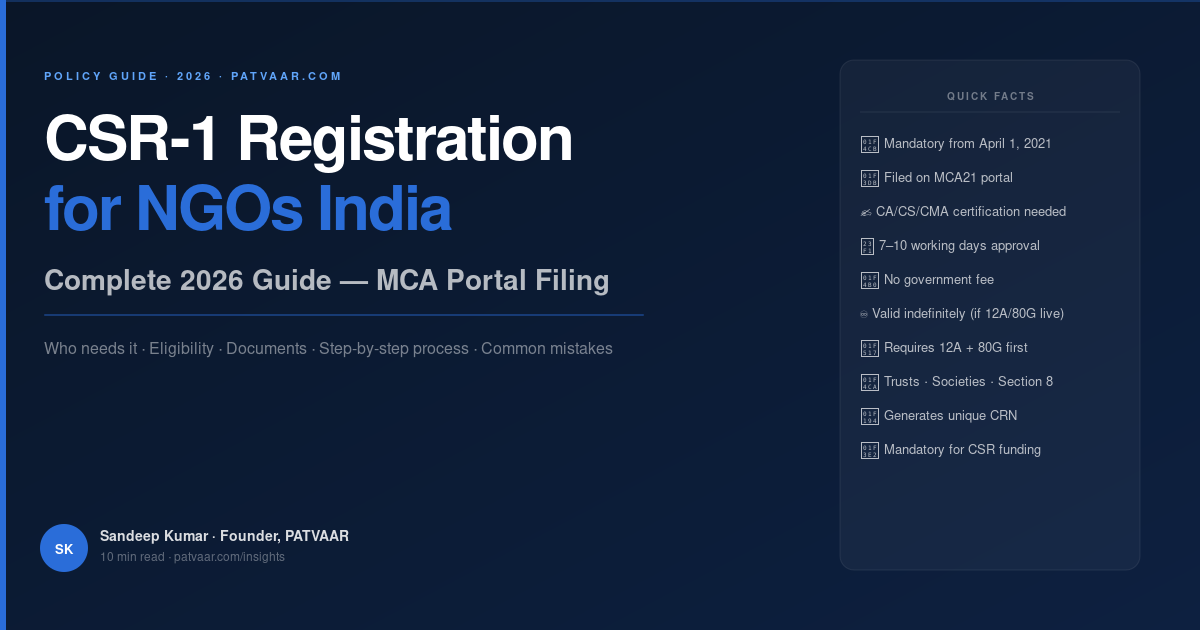
The entire process is online through the MCA portal at mca.gov.in. Step 1: Register on MCA21 Portal with the NGO PAN and authorised signatory details. Step 2: Download Form CSR-1 from MCA Services section. Step 3: Fill Part A with organisational details including NGO name, type, PAN, registration number, 12A and 80G details, and trustee/director information with DINs. Step 4: Get Part B certified by a practising CA, CS or CMA using their digital signature — this is mandatory. Step 5: Apply DSC and submit. No government fee is charged. Step 6: Receive your unique CSR Registration Number (CRN) within 7 to 10 working days.
After Registration — What You Get
Once approved, you receive a CSR Registration Number (CRN) — a unique identifier that companies must quote in their board resolutions and transfer records when funding your NGO. Your CRN is valid indefinitely as long as your underlying registrations remain active. There is no renewal required for CSR-1 itself.
Common Mistakes NGOs Make With CSR-1
- Applying before 12A/80G is renewed — The form will be rejected. Always ensure underlying registrations are current before filing.
- Using an expired DSC — Digital Signature Certificates expire every 2 to 3 years. Check validity before filing.
- Not updating CRN with funders — Once you have your CRN, proactively share it with existing and prospective CSR partners.
- Treating CSR-1 as the end of compliance — CSR-1 is the entry ticket. Companies will still conduct due diligence on your financials, governance and track record.
- Confusing CSR-1 with CSR-2 — CSR-2 is filed by companies to report their CSR spending. NGOs do not file CSR-2.
Frequently Asked Questions
Is CSR-1 mandatory for all NGOs? Only for NGOs seeking CSR funds from companies under Section 135 of the Companies Act 2013.
What is the fee for CSR-1? No government fee. Professional fees to a CA/CS/CMA typically range from Rs 5,000 to Rs 20,000.
Does CSR-1 need renewal? No fixed expiry — but it lapses if your 12A or 80G expires.
How long does it take? Typically 7 to 10 working days after successful submission.
Can a company fund an NGO without CSR-1? No. Companies are legally prohibited from transferring CSR funds to NGOs without a valid CRN.
How PATVAAR verifies information
Our process has several layers. First, our verification team reviews every document an NGO uploads. Second, where the issuing department publishes a portal (for example the Ministry of Corporate Affairs, the Income Tax Department, the FCRA portal of the Ministry of Home Affairs or the ICAI UDIN portal), we cross-check the document against it for validity and for a match with the registered name, and we record the reviewer and the date. Third, registration numbers, UDINs and certificate details are checked online for authenticity wherever that is possible.
Where an item cannot be confirmed from an official source, it is recorded as a manual review, with written notes and a supporting evidence file. That file can be, for example, a declaration signed by the authorised signatory or the chartered accountant of the organisation. It is not shown as an official-portal verification. For project information, our team may, where the project details call for it, contact a sample of beneficiaries or check a project site. A Trust Score is published only when the required evidence has passed review, and payments never affect a score. Review typically takes three to seven working days once the documents are complete.
Read the details in our verification standards, the scoring methodology and the data sources.
Official sources and related guides
- Ministry of Corporate Affairs
- National CSR Portal
- Income Tax Department: Form No. 105 FAQs
- ICAI UDIN portal
- 12A and 80G under the Income-tax Act, 2025 (Form 105)
- CSR funding guide and sector pages
- How to check if an NGO is genuine: a donor checklist
- Verification standards
Last reviewed on 9 November 2026. Rules change, so confirm the current position on the official site before you act. This article is general information, not legal or tax advice.
Related guides