I have sat on both sides of this conversation — as someone who has spent years understanding how corporate CSR functions work, and as the founder of a platform that has reviewed hundreds of NGO profiles. What I am about to share is not from a textbook. It is what I have seen CSR managers actually do when a proposal lands on their desk. Most NGOs have no idea what happens after they hit send. This guide changes that.
The gap between what NGOs think CSR teams do and what they actually do is enormous. NGOs imagine a careful, thorough read of every proposal. The reality is closer to 90 seconds of scanning, a quick Google search, and a decision to either shortlist or move on. Understanding that reality is not discouraging — it is liberating, because once you know exactly what a CSR manager looks for in those 90 seconds, you can make sure it is there.
Why I Built PATVAAR — And What I Learned About Due Diligence
When I started building PATVAAR, I spent months talking to CSR managers, foundation heads, and corporate giving teams across India. I asked them one question: why do you keep funding the same organisations?
Every single answer came back to the same thing — trust. Not quality of work. Not reach. Not impact. Trust. And the specific kind of trust they meant was: I can verify this organisation quickly, confidently, and without putting my own credibility at risk with my board.
That insight — that the funding gap in India's NGO sector is fundamentally a verification gap, not a quality gap — is what PATVAAR is built on. And it completely changed how I understood due diligence. Due diligence is not an evaluation of your work. It is an evaluation of your verifiability.
What Actually Happens When Your Proposal Arrives
Let me walk you through what I have learned happens, step by step, when a CSR proposal lands at a mid-to-large company.
First, it usually does not land with the decision maker. It lands with a CSR executive or program manager who is reviewing anywhere between 50 and 300 proposals for that funding cycle. Their job is to create a shortlist — typically 8 to 15 organisations — that the CSR head or committee will review. Your proposal needs to survive this first filter, and this person has about 90 seconds per proposal.
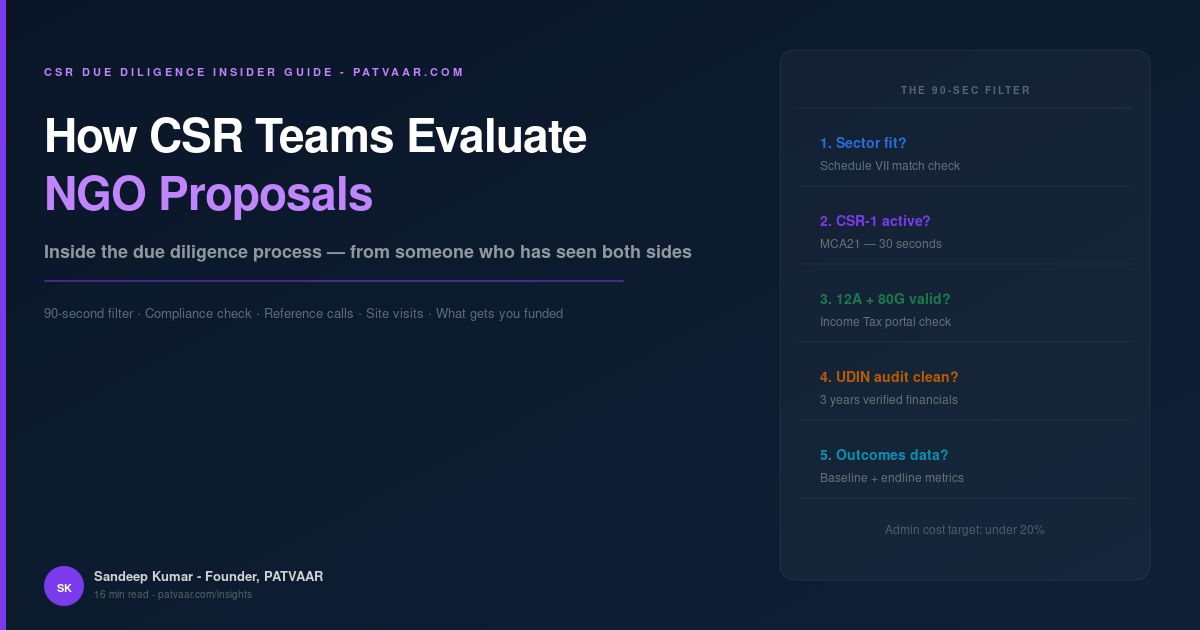
In those 90 seconds, they are looking for three things in order: Does this fit our focus? Does this organisation look credible? Is the ask reasonable? If the answer to any of these is unclear or no, the proposal does not make the shortlist. Not because you did bad work. Because they do not have time to dig further.
The hard truth I share with every NGO founder: Your proposal is not competing against other proposals on the quality of your work. It is competing on the clarity of your credibility. A mediocre proposal from a well-known, easily verifiable organisation will beat an excellent proposal from an unknown one almost every time.
The First Filter — Sector and Geography Fit
This one should be obvious, but I am constantly surprised by how many NGOs ignore it. Every company that spends on CSR has a published CSR policy that specifies which Schedule VII categories they fund, which geographies they prioritise, and often which target populations they focus on. This is in their annual report, which is a public document.
When I talk to CSR managers, they tell me that a significant portion of proposals they receive are immediately irrelevant — an education NGO approaching a company whose CSR policy focuses entirely on environment and water conservation, or a Maharashtra-based organisation applying to a company that only funds in Rajasthan near its manufacturing facilities. These proposals are rejected in seconds, regardless of their quality.
Before you write a single word of a proposal, read the target company's last three annual reports. Find the CSR section. Understand their Schedule VII allocation. Look at which organisations they have funded before. If your work genuinely fits — and only if it fits — then proceed.
The Compliance Check — What They Verify First
Assuming your proposal passes the fit filter, the next thing a CSR team does is a quick compliance check. This typically takes three to five minutes and covers the same five things every time.
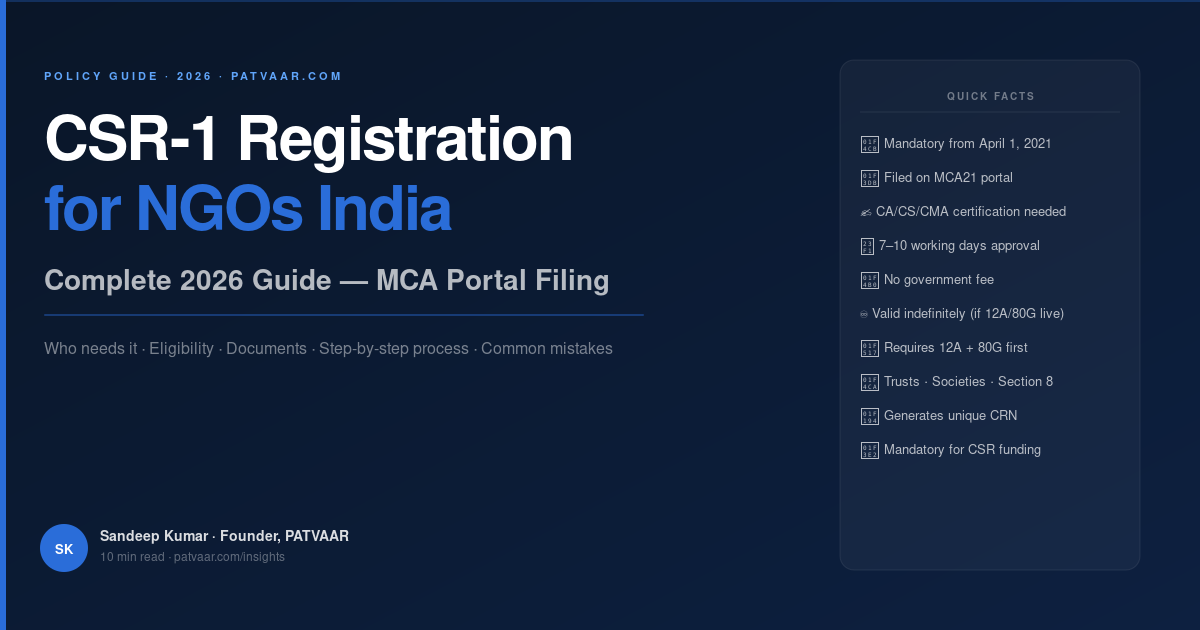
They check your CSR-1 registration on the MCA portal. Since April 2021, this is mandatory for any organisation receiving CSR funds. If your CSR-1 is not active or does not show up cleanly on MCA21, the conversation is usually over. I have heard CSR managers say they do not even read the proposal further if CSR-1 does not check out. Read our complete CSR-1 registration guide if you need to get this in order.
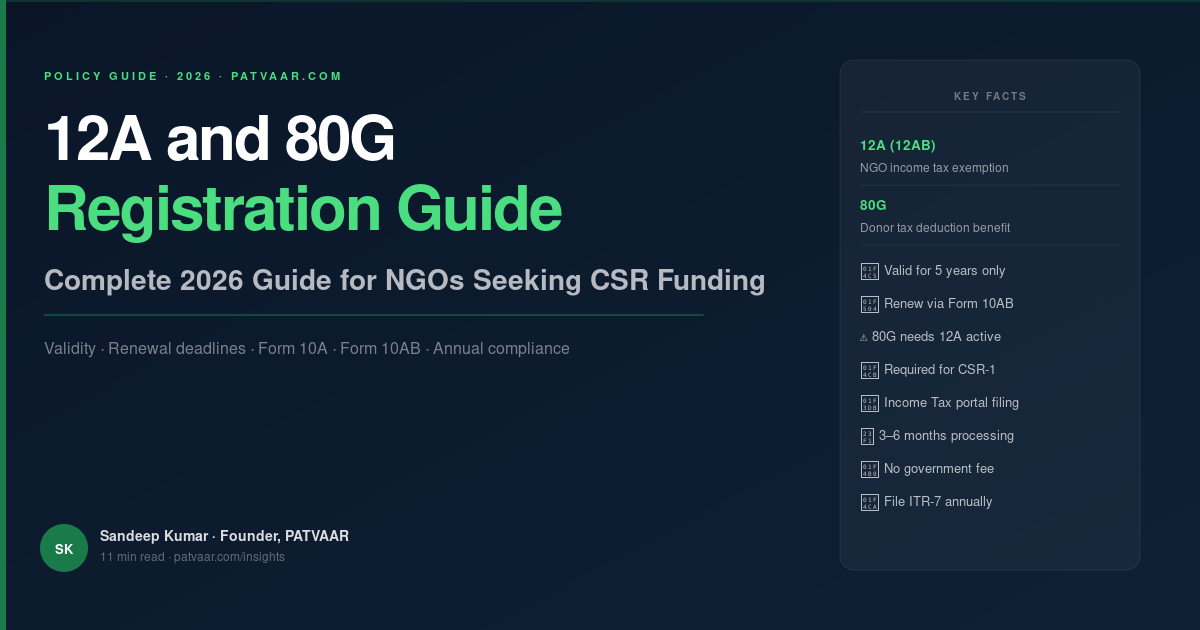
They check your 12A and 80G status on the Income Tax portal. This takes 30 seconds. If either has lapsed or does not appear, they note it as a risk. A lapsed 12A is a red flag — it suggests an organisation that does not manage its own compliance, which raises questions about whether it will manage the grant properly.
They check FCRA on the MHA portal if the funding involves any foreign source. This is increasingly relevant as companies with foreign parents or foreign-funded CSR budgets are technically required to route funds through FCRA-registered entities.
They look for audited financial statements. Not just any accounts — UDIN-verified audited accounts for at least the last three years. The UDIN number confirms the audit is genuine. I have seen cases where CSR teams discovered that an NGO's accounts were self-prepared and presented as audits. That immediately disqualifies the organisation and puts it on an informal blacklist that gets shared through the small world of CSR professionals.
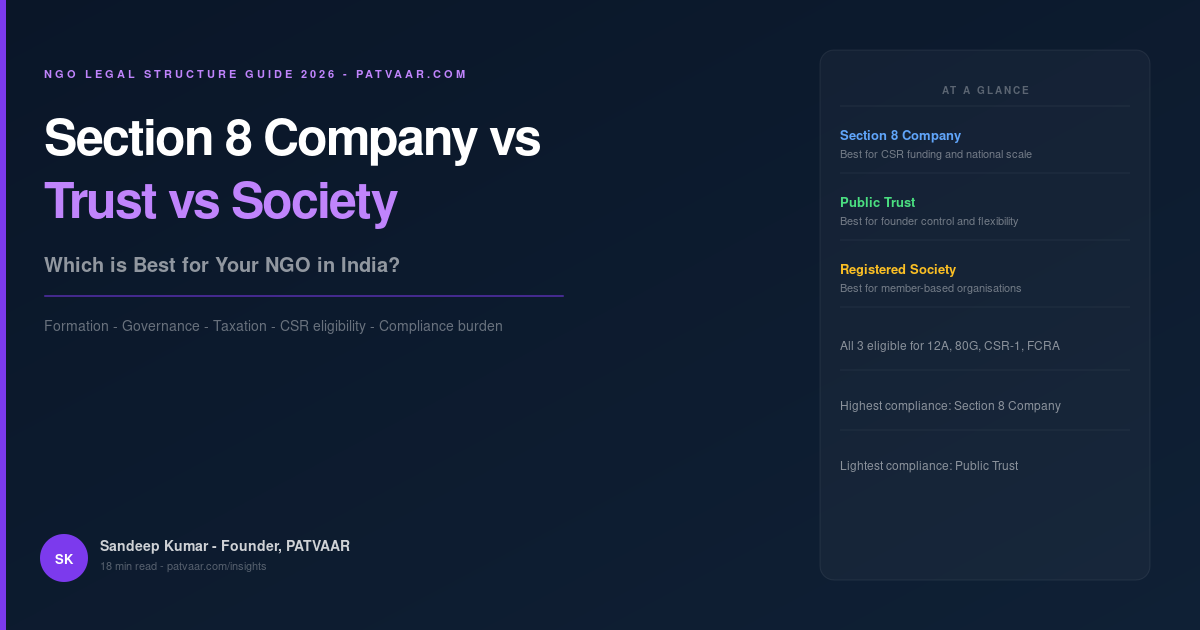
They check the MCA21 company master data if you are a Section 8 Company, which shows director details, filing history, and whether annual returns have been submitted on time. A Section 8 Company with missing annual return filings signals governance problems before anyone has read a single page of your proposal.
The Google Test — What Your Digital Footprint Says
After the compliance check, almost every CSR team I have spoken with does a quick Google search. Not a deep research exercise — a 60-second scan of what comes up when they search your organisation's name.
What they are looking for, and what they want to not find, are two different lists. They want to find a website that looks legitimate, recent news or coverage in credible outlets, social media presence that reflects active operations, and ideally the annual reports I mentioned above available for download.
What they do not want to find is any controversy — news articles about fund misuse, complaints on consumer forums, or negative coverage. They also worry when they find almost nothing. A significant organisation that has no digital presence at all raises questions about whether it is genuinely operational.
Your digital footprint is part of your due diligence profile whether you think of it that way or not. A clean, current website with downloadable annual reports, your CSR-1 and registration numbers displayed, and evidence of actual program work is worth more than three additional pages of proposal content.
The Proposal Review — What They Read and Skip
If your proposal survives the fit filter, the compliance check, and the Google test, it gets an actual read. Here is what I have learned about how CSR professionals read proposals — and most NGOs get this completely wrong.
They read the executive summary first and often last. If the executive summary is clear, specific, and answers all three questions — what you will do, what will change, and what it will cost — many CSR managers will skim the rest and move to evaluation. If the executive summary is vague or takes too long to get to the point, the detailed sections often do not get a thorough read at all.
They go straight to the budget. The budget tells a CSR professional more about an organisation's maturity than almost any other section. They look at the total ask, the cost per beneficiary (they calculate this themselves if you do not provide it), and the administrative cost ratio. I consistently hear that administrative costs above 20% of the total grant raise immediate concern. Costs above 30% are usually a deal breaker without exceptional explanation.
They look at the outcomes section with specific attention to baselines. Proposals that promise outcomes without establishing a baseline are immediately weaker than those that say "we measured X at the start of the program and will measure Y at the end." The absence of baseline data tells a CSR manager that the organisation either has not done this before or is not planning to measure what actually changes.
They look at the team and governance section to find out who is running the organisation. A board that consists entirely of the founder's family members, or a team section that lists the founder and no one else, signals concentration of control that experienced funders treat as governance risk. This does not disqualify you — but it prompts more questions in due diligence.
The Reference Check — The Step Most NGOs Do Not Prepare For
If a proposal makes the shortlist, the next step in most serious CSR due diligence processes is a reference check. This is the step that almost no NGO thinks about when writing a proposal, and it is where genuinely strong organisations differentiate themselves from those who only look good on paper.
CSR teams typically contact two or three people — a previous funder, a government official who has worked with the organisation, a community leader or beneficiary organisation, or a peer NGO. They ask a simple question: what is your experience working with this organisation?
The answers reveal things that no proposal can: whether the organisation delivers what it promises, whether it communicates proactively when things go wrong, whether it handles money responsibly, and whether the people in it are trustworthy in the field as well as on paper.
I always advise NGO founders to treat every existing relationship as a future reference. How you manage your current grants — the communication, the reporting, the honesty about challenges — is building or destroying your reference network continuously. The CSR manager who funds you today may be the reference call for the funder you are approaching in three years.
The Site Visit — When It Happens and What It Means
Not every CSR due diligence process includes a site visit, but for grants above a certain size — typically Rs 50 lakh and above — many companies conduct or commission one. Knowing this changes how you should think about your program design and documentation.
A site visit is not primarily about seeing your facilities. It is about confirming that the beneficiaries, communities, and activities you described in your proposal actually exist. I have spoken with CSR professionals who have visited organisations and found that the program described in the proposal bears little resemblance to what is happening on the ground — inflated beneficiary counts, activities that were conducted once and described as ongoing, partner organisations that do not know they are listed as partners.
When a site visit reveals a gap between the proposal and reality, the organisation does not just lose that grant. It gets added to an informal blacklist that circulates among CSR professionals in that industry. The CSR sector in India is smaller than it appears, and reputational damage travels fast.
The right way to prepare for a site visit is simply to ensure that your program operations match your program description at all times — not just when you expect to be visited. Accurate reporting is also the best site visit preparation.
What Gets You Shortlisted When Others Do Not
After everything I have learned about how CSR due diligence works, I want to share the specific things that I have seen consistently differentiate the organisations that get funded from those that do not — beyond the compliance basics.
Independent verification beats self-reported credibility every time. An organisation that can point to an independently verified Trust Score, a third-party impact assessment, or an external audit that goes beyond the minimum requirement removes the verification burden from the CSR team. The funder does not have to trust what you say about yourself — they can verify it independently. This is the core insight behind PATVAAR's Trust Score, which cross-references your documents against government databases rather than taking anything on your word.
Proactive transparency about weaknesses builds more trust than perfect presentations. The CSR professionals I respect most have told me that they are immediately suspicious of proposals that describe only successes. Real programs have challenges. An organisation that can articulate what did not work in a previous program and what it learned tells a funder far more about its maturity than one that presents a uniformly positive track record.
Specific outcome data with a clear measurement methodology is the single most effective proposal differentiator. Not "we will improve literacy" but "we will increase the percentage of Class 3 children reading at grade level from 34% baseline (measured September 2026) to 60% by March 2028, using the ASER oral reading assessment administered by an independent assessor to a stratified sample of 200 children." That level of specificity tells a CSR professional that you understand what you are trying to achieve, you have a way to measure it, and you are willing to be held accountable to the result. Read our guide on impact measurement for NGOs for exactly how to build this framework.
Cost per beneficiary that compares well against alternatives. CSR professionals are increasingly sophisticated about cost effectiveness. They often know the typical cost per beneficiary for the type of program they fund. An organisation whose cost per beneficiary is significantly higher than the norm without explanation will raise questions even if everything else looks strong.
The Due Diligence Checklist CSR Teams Use
Based on everything I have described, here is the consolidated due diligence checklist that I have seen CSR teams use in various forms. If you can answer yes to every item on this list before submitting a proposal, you are genuinely ready.
How PATVAAR Changes the Due Diligence Conversation
Everything I have described above — the compliance checks, the reference checks, the site visits, the Google searches — exists because there is no standard, independently verified way to establish NGO credibility in India. CSR teams have to build these processes from scratch for every funding decision, which is time-consuming, expensive, and still imperfect.
PATVAAR verifies the core elements of NGO credibility independently — compliance against government databases, financial discipline through UDIN-verified audits, governance through board documentation, reporting through outcome data, and operations through field verification — and publishes a single Trust Score that a CSR team can check in seconds.
When an NGO on PATVAAR sends a proposal, the CSR manager's compliance check takes 10 seconds instead of 10 minutes. The verification is already done, independently, against the same government sources the CSR team would check manually. That reduction in friction accelerates the funding decision and gives verified organisations a meaningful advantage over those who have to be taken on faith.
If you have read this guide and you are serious about getting CSR funding, the next step is getting verified. Understand what the PATVAAR Trust Score measures and how to improve it, get your compliance in order, and apply. Verification is free during Beta and takes seven working days. Apply here.
Pass the 90-second test — every time.
Get independently verified on PATVAAR. Free during Beta. Published in 7 days.
Frequently Asked Questions
How long does CSR due diligence take in India?
It varies significantly by company and grant size. For smaller grants below Rs 25 lakh, the process may take two to four weeks from proposal submission to decision. For larger grants above Rs 1 crore, full due diligence including site visits and reference checks can take two to four months. The initial filter — whether your proposal makes the shortlist — happens within days of submission.
What is the first thing CSR teams check when they receive a proposal?
Sector and geography fit comes first — does your work match what the company funds? If yes, the next check is almost always CSR-1 registration on the MCA portal. This takes 30 seconds and eliminates a significant portion of proposals immediately.
Do all CSR teams conduct site visits?
Not all, but most serious CSR programs conduct site visits for grants above Rs 50 lakh. Smaller grants may be approved on documentation alone. Even when a formal site visit is not conducted, CSR teams increasingly commission third-party verification of program operations.
What is the most common reason CSR proposals get rejected?
From my experience and conversations with CSR professionals, the most common reasons are sector mismatch, compliance gaps (particularly CSR-1 and lapsed 12A or 80G), vague outcome statements without baselines, and administrative cost ratios that are too high. Poor writing is rarely the primary issue — it is almost always substance.
How important is an NGO's reputation in CSR due diligence?
Extremely important, and it operates through informal channels that most NGOs underestimate. CSR professionals in the same industry or geography talk to each other. An organisation with a strong reputation for delivery and honest reporting will receive warm introductions and benefit of the doubt. An organisation with any history of misuse or over-promising will find doors closed without ever knowing why.
What does a CSR team look for in an NGO's financials?
Three things primarily: administrative cost ratio (below 20% is the general expectation), evidence of clean fund utilisation with proper receipts and documentation, and consistent auditing by the same CA firm over multiple years (changing auditors every year is a yellow flag). The financials should tell a story of an organisation that handles money responsibly and transparently.
How does PATVAAR verification help in CSR due diligence?
PATVAAR independently verifies the core elements of NGO credibility against government databases — CSR-1 on MCA21, 12A and 80G on the Income Tax portal, UDIN on the ICAI portal, and FCRA on the MHA portal — and publishes a five-pillar Trust Score. This compresses the compliance check from ten minutes of manual work to ten seconds, removes the self-reporting problem, and gives CSR teams a standardised credibility signal they can rely on.