If you are starting a non-profit organisation in India, the first decision you face is also one of the most consequential: which legal structure to choose. Section 8 Company, Public Charitable Trust, or Registered Society — each has distinct advantages, limitations, tax implications, and compliance requirements. The wrong choice early on can take years to correct. This guide gives you a complete, honest comparison so you can make the right call from the start.
There is no universally correct answer. The best structure for your organisation depends on your funding sources, governance preferences, geography, long-term plans, and the kind of credibility you want to project to CSR teams and institutional funders. What works for a community-level welfare society in a small town is different from what works for a national-scale education foundation seeking corporate CSR funding.
The Three Legal Structures — A Quick Overview
Section 8 Company is a company incorporated under the Companies Act 2013 with the specific objective of promoting commerce, art, science, sports, education, research, social welfare, religion, charity, or protection of the environment. It is called Section 8 because that is the section of the Companies Act that governs it.
Public Charitable Trust is a legal entity created through a Trust Deed under the Indian Trusts Act 1882 or state-specific public trust acts such as the Bombay Public Trusts Act 1950. The Trust Deed defines the objectives, trustees, and governance of the trust.
Registered Society is an association of persons registered under the Societies Registration Act 1860 or its state equivalents. Societies are governed by their Memorandum of Association and Rules and Regulations, and managed by a governing body elected by members.
Formation and Registration
Section 8 Company
A Section 8 Company is registered with the Registrar of Companies through the MCA21 portal. The process involves obtaining a Digital Signature Certificate for all directors, applying for Director Identification Numbers, reserving a company name, and filing the SPICe+ form. The entire process is centralised on the MCA portal and governed by uniform national rules. Typical timeline: 30 to 45 days. Minimum 2 directors required.
Public Charitable Trust
Trust registration is state-specific. In Maharashtra it is registered with the Charity Commissioner. In Delhi, a public charitable trust is registered by executing a Trust Deed on stamp paper and getting it registered with the Sub-Registrar of Assurances. Timeline varies from 2 weeks in simple states to 6 months in Maharashtra and Gujarat.
Registered Society
Societies are registered with the Registrar of Societies at district or state level. Minimum 7 members required. Annual general body meetings and elections are mandatory. Timeline: 1 to 3 months depending on state.
Governance and Control
Section 8 Company — Corporate Governance Framework
A Section 8 Company is governed like a company with a Board of Directors, mandatory board meetings, resolutions, minutes, and annual filings. Every significant decision requires a board resolution. The MCA maintains a public record of all filings, director details, and annual returns visible to anyone who checks. This transparency makes Section 8 companies the most credible structure in the eyes of institutional funders and CSR teams.
Public Charitable Trust — Founder Flexibility
A Trust is the most founder-friendly structure in terms of control. The founding trustees can define the governance structure in the Trust Deed, including how new trustees are appointed, what decisions require trustee consensus, and how the trust can be amended. Many trusts operate with the founder as Managing Trustee with significant day-to-day authority.
Registered Society — Democratic but Complex
A Society has the most democratic governance structure. It is governed by its general body of members with a managing committee elected by members. Annual general meetings are mandatory, elections must be conducted, and minutes must be maintained. Governance disputes between founding members and newly elected committees are one of the most common reasons for NGO dysfunction in India.
Taxation — 12A, 80G and Compliance
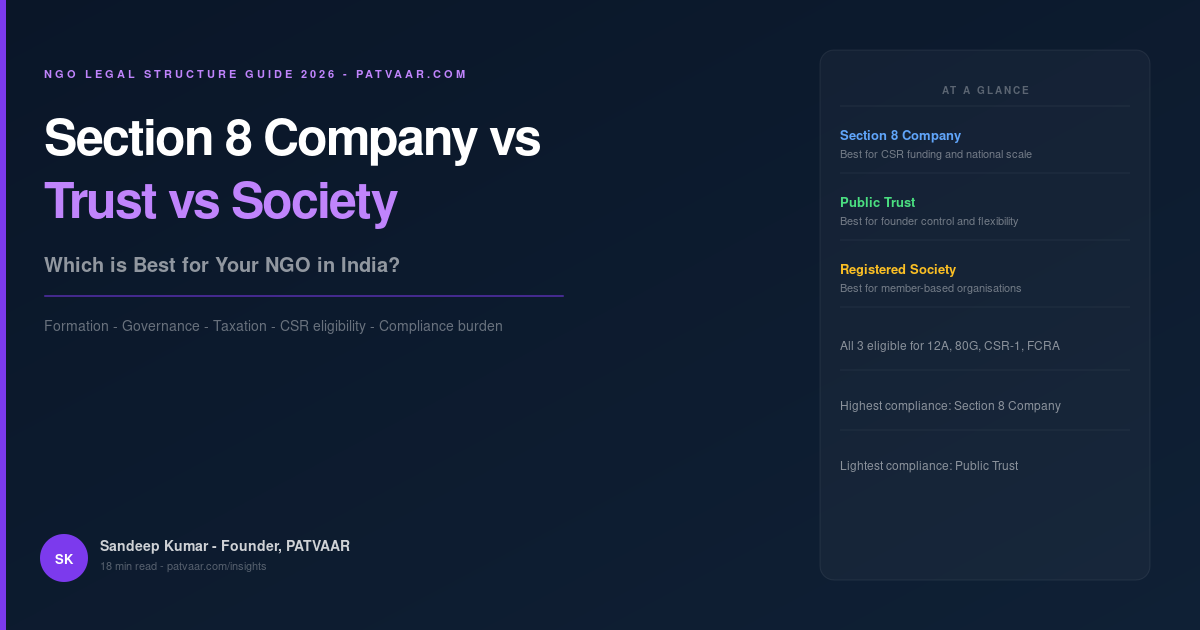
All three structures are eligible for 12A income tax exemption and 80G donor tax benefit. The Income Tax Act does not distinguish between them. However Section 8 Companies must file annual returns under the Companies Act in addition to ITR-7, doubling the compliance burden.
For all three structures, key tax compliance requirements are:
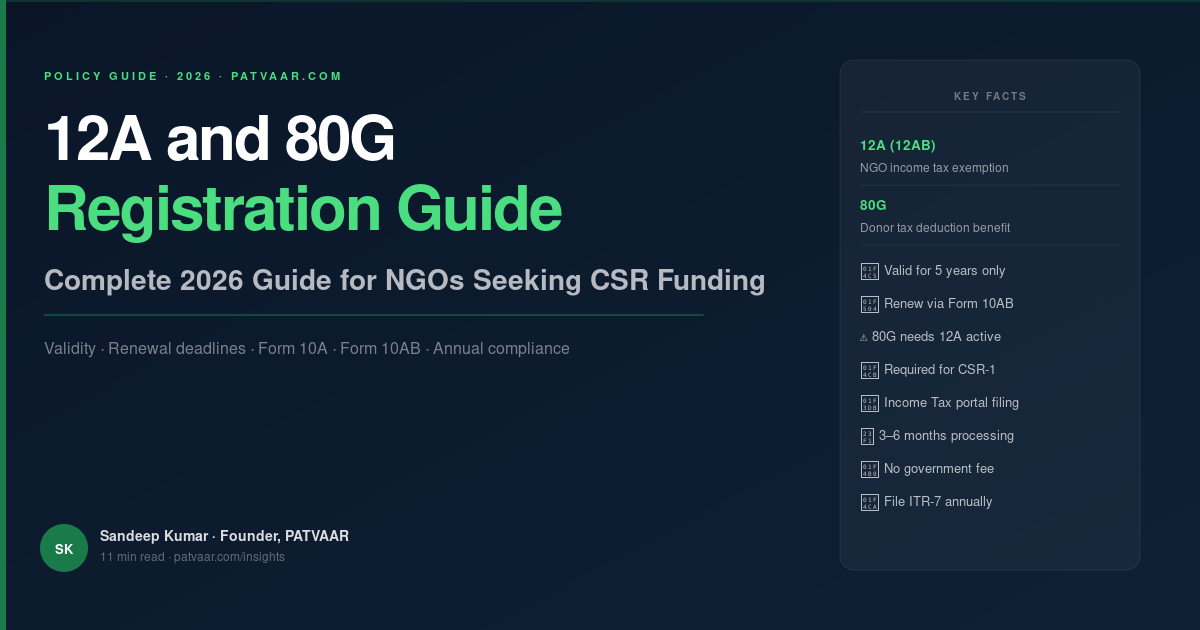
- 12A / 12AB registration for income tax exemption — valid 5 years, renewal via Form 10AB
- 80G registration for donor tax benefit — valid 5 years, renewal via Form 10AB
- Annual ITR-7 filing by October 31 each year
- Form 10B or 10BB audit report — mandatory if income exceeds Rs 5 lakh
- At least 85% of income must be applied to charitable purposes each year
Compliance Burden — The Real Cost
The Section 8 Company has the highest ongoing compliance burden by a significant margin.
Section 8 Company annual requirements: 4 board meetings minimum, Annual General Meeting, Form MGT-7, Form AOC-4, Director KYC annually, ITR-7, Form 10B audit. Professional fees: Rs 50,000 to Rs 1,50,000 per year.
Trust annual requirements: Annual return with Charity Commissioner where applicable, ITR-7, Form 10B. Professional fees: Rs 25,000 to Rs 60,000 per year.
Society annual requirements: Annual return with Registrar, AGM with minutes, ITR-7, Form 10B, election records. Professional fees: Rs 30,000 to Rs 80,000 per year.
Warning: The most common reason NGOs lose 12A and 80G registrations is failure to file annual returns on time — not fraud. The higher compliance burden of Section 8 Companies makes them statistically more likely to have a missed filing.
CSR Funding Eligibility — How Each Structure Is Perceived
All three structures are eligible for CSR-1 registration. In practice however CSR teams perceive them differently.
Section 8 Company has the highest perceived credibility. All information is publicly verifiable on MCA21 — director details, filing status, financial data — without asking the NGO for anything. Large companies with systematic CSR programmes consistently show preference for Section 8 Companies as implementing partners.
Public Trust is highly credible when well-governed with a clean Charity Commissioner record. The limitation is that trust information is not centralised nationally. A Delhi trust is harder to verify since Delhi has no Charity Commissioner.
Registered Society has the most variable credibility profile. The ease of forming a society has led to a large number of non-functional societies in the NGO database. CSR teams are aware of this and conduct more intensive due diligence on societies.
FCRA Eligibility
All three structures are equally eligible for FCRA registration provided they meet standard criteria: 3 years of existence, ITR-7 filings for 3 years, and a charitable track record. The FCRA application process is identical for all three structures, filed with the Ministry of Home Affairs. FCRA registration is valid for 5 years and must be renewed. Annual FCRA returns must be filed by December 31 each year.
Conversion — Can You Change Structure Later?
A trust or society cannot directly convert into a Section 8 Company. The practical path is to incorporate a new Section 8 Company and gradually transfer programmes, assets, and staff. This typically takes 2 to 3 years. The implication: choose carefully at formation. The cost of conversion in time, legal fees, and disruption to funding relationships is significant.
Which Structure Is Best for Your Situation?
Common Mistakes When Choosing a Legal Structure
Choosing a society because it seems simpler. The AGM and election requirements create ongoing governance work many founders do not anticipate. If operational simplicity is the concern, a trust is usually a better choice.
Forming a trust in Maharashtra or Gujarat without understanding the implications. These states have active Charity Commissioner offices with real oversight. Annual returns are scrutinised and permission is required for certain fund uses.
Prioritising founder control over long-term credibility. As you grow and seek larger CSR mandates, institutional funders will look for evidence of independent governance. Building that structure into your founding documents is significantly easier than retrofitting it later.
Not getting a CA involved from day one. A few hours with an experienced NGO-focused CA will cost Rs 5,000 to Rs 15,000 and save years of problems. It is the best investment you will make in the early stage.
The Compliance Stack You Need Regardless of Structure
Whichever structure you choose, the compliance requirements for CSR-funding-readiness are the same:
- 12A / 12AB registration — income tax exemption. Read our complete 12A and 80G guide
- 80G registration — donor tax benefit
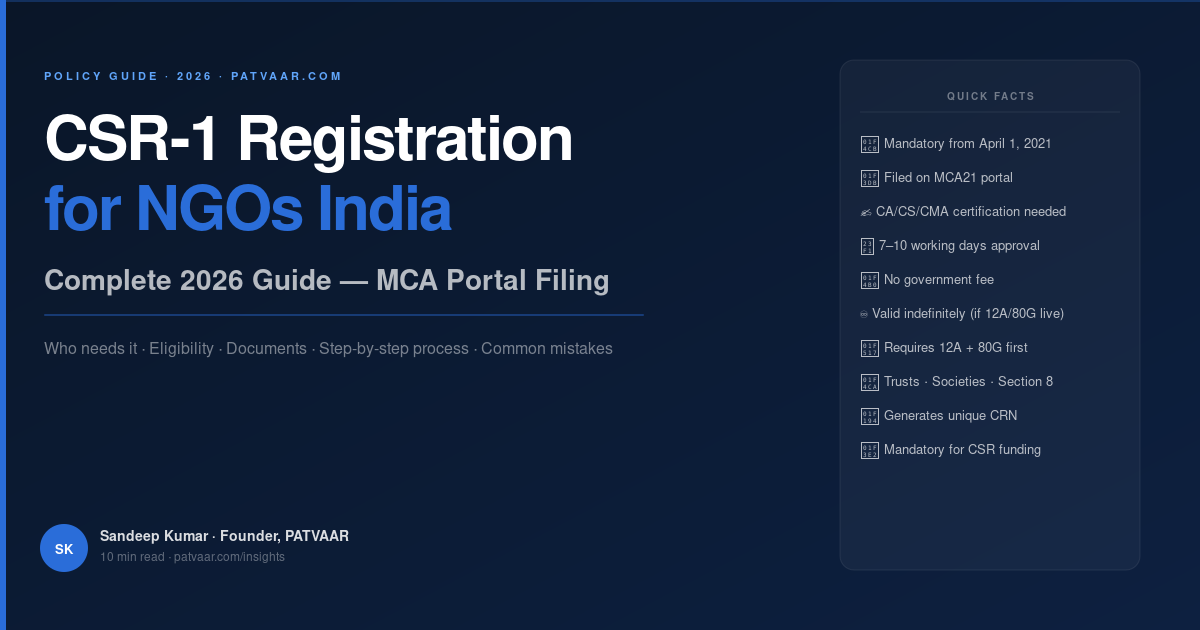
- CSR-1 registration — mandatory since April 2021. Read our complete CSR-1 guide
- 3 years UDIN-verified audited financials
- Updated board or trustee composition with DINs
- Annual Report with impact data
Once your compliance stack is in place, PATVAAR verifies all of it and publishes your Trust Score — visible to every CSR team on the platform. All three structures are eligible. Get your free Trust Score here.
Get your NGO verified — whatever your structure.
Section 8, Trust or Society — all eligible. Trust Score in 7 days. Free during Beta.