Every year, corporate CSR teams transfer hundreds of crores to NGO partners. When those partnerships work, they produce real impact and clean compliance records. When they do not, the consequences fall entirely on the company — reputational damage, regulatory scrutiny, and in some cases, personal liability for directors. The difference almost always comes down to how rigorously the NGO was evaluated before the first rupee was transferred.
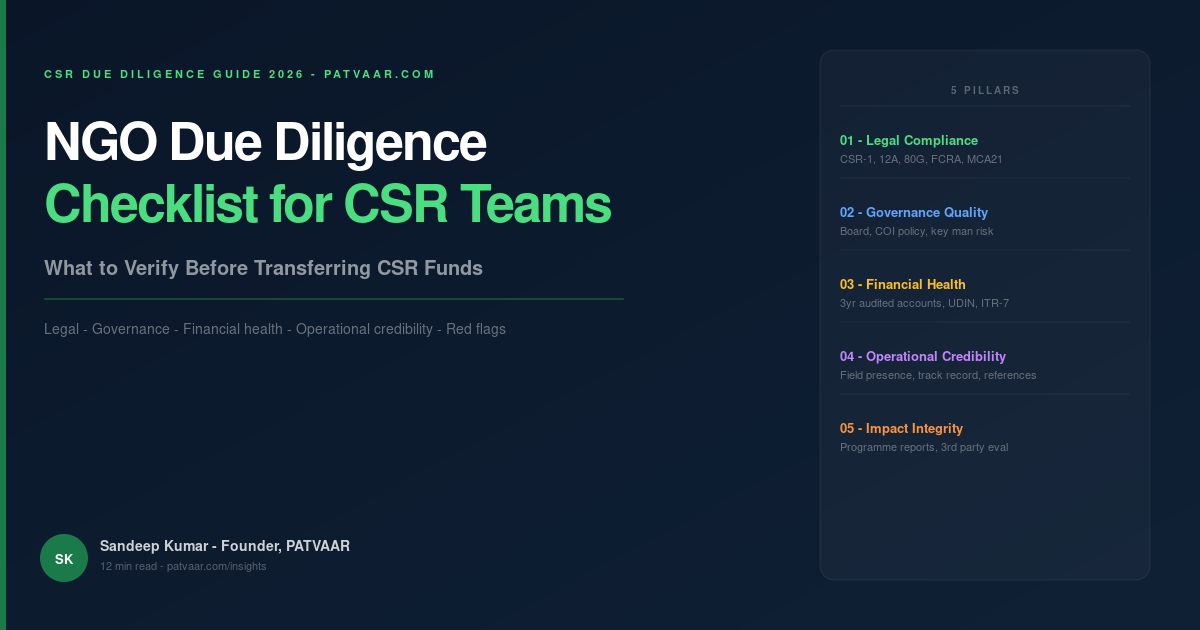
This checklist is built for CSR managers, foundation programme officers, and compliance teams who need a structured, document-based framework for evaluating NGO partners before committing funds. It covers every dimension that matters — legal standing, governance quality, financial health, operational credibility, and impact integrity.
Why NGO Due Diligence Matters More Than Ever
The Companies Act 2013 places direct responsibility on a company's CSR Committee for the proper utilisation of CSR funds. Under Rule 4 of the Companies (CSR Policy) Rules 2014, companies must conduct due diligence before engaging implementing agencies. The CSR-2 annual filing now requires companies to disclose implementing agency details, fund utilisation, and project outcomes — all of which are scrutinised by the MCA.
The risk landscape has also changed. The 2021 amendments to CSR rules introduced stricter monitoring requirements, mandatory impact assessment for grants above Rs 1 crore in a financial year, and tighter reporting timelines. A CSR transfer to an unverified or non-compliant NGO is no longer just a reputational risk — it can constitute a compliance failure.
Key risk: Under Section 135(5), unspent CSR funds not transferred to a designated fund within the prescribed timeline attract penalty under Section 135(7). Transfers to non-compliant NGOs may be treated as unspent CSR — exposing the company and its directors to penalty.
Part 1 — Legal and Compliance Verification
This is the foundation of any NGO due diligence. Every item in this section must be verified against primary government sources — not taken at face value from documents provided by the NGO.
1.1 CSR-1 Registration
Since April 1, 2021, any NGO receiving corporate CSR funds must have a valid CSR Registration Number (CRN) issued by the MCA. This is a hard legal requirement. Verify the CRN directly on the MCA21 portal — do not rely on a document copy from the NGO.
What to check: CRN is valid and active, registered entity name matches the NGO you are evaluating, and the registration has not been suspended or revoked. For a detailed walkthrough of the CSR-1 process, read our complete CSR-1 registration guide.
1.2 12A Certificate
The 12A certificate — now 12AB after the 2021 amendments — exempts the NGO income from tax. Since 2021, 12A is valid for 5 years only. An expired 12A means the NGO income is taxable, which affects how it can use your grant. Verify on the Income Tax e-filing portal using the NGO PAN.
1.3 80G Certificate
The 80G certificate allows your company to claim a 50% deduction on the CSR contribution against taxable income. Like 12A, 80G is now valid for 5 years only after the 2021 amendments. Ensure the 80G is not provisionally granted — only final 80G certificates are valid for deduction claims.
For a detailed breakdown of 12A and 80G requirements, read our complete 12A and 80G guide.
1.4 MCA21 Legal Registration
Verify the NGO foundational legal registration — Trust Deed, Society Registration Certificate, or Certificate of Incorporation for Section 8 companies. For societies and trusts, check with the relevant state registrar. For Section 8 companies, verify on MCA21. Confirm registration is active and not struck off.
1.5 FCRA Status
If your company has any foreign shareholder ownership above 50%, your CSR contribution may be classified as a foreign contribution under FCRA, requiring the NGO to hold a valid FCRA registration. Check FCRA status on the MHA FCRA portal.
Part 2 — Governance and Leadership Verification
Weak governance is the most common root cause of NGO failures, fund misutilisation, and project delays. A compliance-perfect NGO with poor governance is still a high-risk partner.
2.1 Board Composition
Request the current list of trustees or directors with their full names, DINs for Section 8 companies, and designations. A credible NGO board has at least 3 to 5 members with relevant expertise. Watch for boards dominated by family members, boards with only 2 members, or boards where the same person holds multiple key roles.
What to check: Board has been updated with the registrar — compare against MCA or state registrar records. No trustee has been disqualified from directorship. At least one independent member with no family relationship to the founder.
2.2 Conflict of Interest Policy
Ask directly: does the organisation have a written conflict of interest policy? Are related-party transactions disclosed in the annual report? NGOs that purchase services from trustee-owned companies without disclosure are a serious governance red flag.
2.3 Key Man Risk
Assess whether the organisation is overly dependent on a single individual — typically the founder. If that person were unavailable for 6 months, would the organisation continue to function? NGOs with strong second-tier leadership and documented systems carry significantly lower delivery risk.
2.4 Staff Strength and Retention
Request a current organogram and staff headcount by function. High staff turnover — particularly at programme manager level — is a leading indicator of delivery problems. Ask specifically about turnover in the last 2 years.
Part 3 — Financial Health Assessment
Financial due diligence is where most CSR teams invest the least time and where the most critical risks are hidden. A proper financial assessment requires reviewing 3 years of audited statements, not just the most recent year.
3.1 Audited Financial Statements with UDIN
Request audited financial statements for FY2023, FY2024, and FY2025. All statements must be certified by a practising Chartered Accountant with a valid UDIN. Verify the UDIN for each statement on the ICAI UDIN portal — this confirms the CA actually certified those specific statements and they have not been tampered with.
3.2 Programme Spend Ratio
The programme spend ratio — the proportion of total expenditure that goes directly to programmes rather than administration and fundraising — is the single most important financial metric for CSR due diligence.
3.3 Fund Utilisation Certificates
If the NGO has received grants from other CSR funders previously, request utilisation certificates for those grants. A clean utilisation certificate — submitted on time, with UDIN, and reconciled with the audited accounts — is one of the strongest credibility signals available.
3.4 Income Diversification
Assess the NGO income sources over 3 years. An NGO that is 90% dependent on a single funder carries delivery risk. Look for diversification across government grants, CSR, individual donors, and earned income.
3.5 ITR-7 Filing Status
Verify that the NGO has filed its Income Tax Return in Form ITR-7 for all applicable years. Non-filing is a compliance failure that can affect the validity of 12A and 80G registrations.
Part 4 — Operational and Programme Credibility
4.1 Geographic Presence
Verify that the NGO has actual operational presence in the geography where you intend to fund programmes. Request field office addresses, staff names, and a reference contact at the district or block level — a government official, school principal, or primary health centre head who can confirm the NGO presence.
4.2 Programme Track Record
Request project completion reports for the last 2 to 3 programmes. Credible reports include: baseline data, midline and endline measurements, disaggregated beneficiary data by gender and geography, photos with dates and locations, and financial utilisation with line-item reconciliation.
A vague report with only narrative content and no data is a warning sign. An NGO that has been operating for 10 years but cannot produce a single programme report with measurable outcomes has not been building systems.
4.3 Reference Checks
Request references from at least 2 existing CSR funders who have funded the NGO in the last 3 years. Call them directly — do not rely on written references. Ask: Did they deliver on time? Was reporting complete and clean? Would you fund them again?
Part 5 — Red Flags That Should Stop Any Funding Decision
No matter how good the rest of the evaluation looks, any of the following should result in an immediate pause and escalation to your legal or compliance team:
- CSR-1 expired, suspended, or not registered
- 12A or 80G expired and not renewed
- Audited financials without UDIN, or UDIN that fails verification
- ITR-7 not filed for 2 or more years
- Trustee or director listed as disqualified on MCA
- FCRA registration suspended or cancelled
- Significant unexplained variance between audited accounts and utilisation certificates
- NGO unable or unwilling to provide references from existing CSR funders
- Board dominated by family members with no independent oversight
- Founder also serving as treasurer with no independent financial oversight
How to Structure Your Due Diligence Process
A well-run CSR due diligence process has three stages:
Stage 1 — Desk Review (1 to 2 weeks): Document collection and primary source verification. Everything in Parts 1 and 3 above. This stage should be standardised with a fixed checklist and can be partially delegated or outsourced.
Stage 2 — Management Discussion (1 week): A structured conversation with the NGO leadership covering governance, programme design, monitoring systems, financial management, and reporting processes.
Stage 3 — Field Verification (recommended for grants above Rs 25 lakh): A visit to at least one active programme site. Speak to beneficiaries without NGO staff present if possible.
How PATVAAR Changes This Equation
The due diligence process described above typically takes 6 to 10 weeks of staff time per NGO partner. For a CSR team managing 15 to 20 implementing partners, this is enormous duplication — each funder running the same checks independently.
PATVAAR addresses this directly. NGOs verified on PATVAAR have had every compliance document cross-referenced against MCA21, Income Tax Department, UDIN, and FCRA databases. The resulting Trust Score — computed across 5 weighted pillars — dramatically accelerates the desk review stage of due diligence.
Browse verified NGO profiles at patvaar.com/ngo-registry. Register as a funder at patvaar.com/register.
Browse verified NGOs ready for CSR partnerships.
Every NGO on PATVAAR has been document-verified. Trust Scores published. Desk review — accelerated.