The short version. No single paper proves that an NGO is genuine. A genuine organisation can have a messy website and a fraudulent one can have a beautiful certificate. What works is a short sequence of checks: confirm that the organisation exists in law, that its tax and regulatory permissions are current, that its accounts are audited and its name is consistent across every document, and that its work can be seen somewhere other than in its own marketing. Then give in a way that is safe. This guide sets out that sequence for donors, small funders and first-time CSR teams, with where to verify each step.
Two honest notes first. We rely on official sources where we can: NITI Aayog's NGO Darpan pages, the FCRA website of the Ministry of Home Affairs, and the Income Tax Department's Form No. 105 FAQ. We also draw on a donor guide published by Smile Foundation, a large NGO. That guide is useful, and it is also the work of an organisation with an interest in being trusted, so we have used it for its checklist of red flags and have not repeated its claims about itself. And everything here is general information, not legal advice. If you are making a large gift or a funder-level commitment, use a professional.
Start with what you are really worried about
"Is this NGO genuine?" is really three questions, and different checks answer different ones:
- Is it a real, lawful organisation? That is about registration, tax and regulatory permissions.
- Will my money reach it, and be used as intended? That is about bank accounts, accounts and governance.
- Does it actually do the work it describes? That is about evidence on the ground.
Most donor-fraud stories involve a failure at the second question: someone pays into an account that does not belong to the organisation. Most poor-quality giving involves a failure at the third: a real organisation, real receipts, little real activity. Keep all three in mind as you go through the steps.
Step 1: Ask who they are, in law
Ask for the organisation's legal name and its registration documents. A charity in India is typically a trust, a society or a Section 8 company, and each is registered with a different authority. A trust or a society will have a registration certificate (and a trust deed or memorandum). A Section 8 company will have a certificate of incorporation, and the Ministry of Corporate Affairs publishes company information on its website. We could not open every government page when preparing this article, so we do not describe the exact lookup screens; use the Ministry's website to look up the company by name or number and see what it shows.
What you are looking for is simple: the name that is asking for your money should be the name on the registration, and the registration should be what the organisation says it is. A "foundation" that turns out to be an unregistered group, or a "trust" that is actually a private company run for profit, fails the first check.
Step 2: Ask for income-tax registration and approval, if you want a deduction
If you expect a tax benefit on your donation, ask for the NGO's registration and approval orders and read the dates. Under the Income-tax Act, 2025, the Income Tax Department's Form No. 105 FAQ describes regular registration (section 332) and regular approval (section 354) as time-limited, usually five tax years, with an order in Form No. 107 carrying a unique registration number. Old certificates still circulate under the names 12A and 80G, so you may be shown either.
Three questions to put: Is the approval current today? Does the name on it match the name asking for the donation? Are both registration and approval in place? Having one does not mean having the other. Our guide to 12A and 80G under the Income-tax Act, 2025 explains the dates in detail. And note that whether you can actually claim a deduction depends on your own circumstances; ask your own adviser.
Step 3: Check the NGO Darpan ID
NITI Aayog's Voluntary Action Cell maintains the NPO Darpan portal and says that registration there is mandatory for non-profits seeking grants from the Ministries and Departments of the Government of India, and that the ID is needed for FCRA registration or renewal, for 80G and for opening and operating bank accounts. So a serious, established NGO should have one.
But hold the ID lightly. It shows that an organisation registered. It does not show that anyone checked it. The portal has said that IDs are generated from information the organisation supplies, that this does not mean endorsement, and that NITI Aayog does not issue a certificate. If an NGO shows you a paper that claims to be a NITI Aayog certificate, ask for the portal record instead. We explain this in more detail in our guide to the NGO Darpan Unique ID.
Step 4: Check FCRA, if foreign money is involved
An NGO that receives money from abroad needs FCRA registration or prior permission. If it says it does, ask for the registration number or the permission details and check them on the Ministry of Home Affairs' FCRA website, not on a PDF it sends you. A few useful points from the FCRA FAQ: registration is for associations that are not in a formative stage and, generally, have existed for at least three years; it lasts five years and must be renewed; and an annual return in Form FC-4 is due by 31 December for the preceding financial year. See FCRA registration vs prior permission for the details, including the places where the official sources differ.
If an NGO says it has FCRA status and cannot give you a number, that is a reason to stop. If it does not take foreign money at all, FCRA is simply not relevant and you can move on.
Step 5: Read the money documents
Ask for the latest audited financial statements and the annual report. You do not need to be an accountant. Look for these things:
- An auditor's signature and membership number. Statements without a chartered accountant's sign-off are weak evidence.
- Dates. Is the report for the most recent year, or several years old? Is it filed on time?
- A split between programme and administrative costs. It does not need to match a magic percentage. It needs to exist and be explained.
- Who the funders are. A list of donors and amounts is a good sign; a total with no breakdown is less so.
- Consistency. The name, the registration number and the address should match the other documents.
- The people. Names of trustees or directors, and whether the same people recur across the documents.
Be wary of reports that describe outcomes in large round numbers with no locations, dates or partners. A real programme usually leaves ordinary traces: a school, a clinic, a partner institution, a local official, a date.
Step 6: Compare the names
This takes five minutes and catches more problems than any other step. Write down the name on the registration, on the tax order, on the Darpan record, on the FCRA record (if any), on the annual report, on the website, and on the bank account that will receive your money. They should be the same legal entity. Small variations are sometimes innocent (an abbreviation, a missing "Charitable"). Larger ones, for example a "Foundation" collecting money for a "Trust", need an explanation you can verify in writing.
Step 7: Look for work you can see
A paper-perfect organisation with no visible activity is a problem; a modest organisation with visible work is often fine. Look for named project locations, partner institutions, local news coverage, government acknowledgements, photographs with dates and places, and a website that has been around for a while. Ask for a contact at a project site or a partner, and ask if you can visit or speak to someone who has worked with them. Smile Foundation's guide makes a point we agree with: a genuine organisation can show you its legal registration, its financial transparency and its ground presence within a few minutes, and if it cannot, treat that as a warning sign.
If you are in a position to visit, do. If you are not, a short video call with the programme lead, with a request to show you the place, tells you more than a brochure.
Step 8: Pay in the safest way
This is where most fraud happens, and where your attention should be sharpest.
- Pay only into the organisation's own bank account, in its registered name. Confirm the account name matches before you send money.
- Do not pay a personal account or a personal UPI ID, even if the person says they are an office bearer.
- Be cautious about links sent through chat apps, and about "urgent" appeals that discourage you from checking.
- Go to the NGO's own website, typed into the browser, to find the donation details; do not rely on a message.
- Keep the receipt, and the message or page that asked for the money.
- If you want to claim a tax deduction, make sure the receipt carries the details the organisation is supposed to give you, and ask your own adviser what you need.
Red flags, and how many to tolerate
The Smile Foundation guide lists a set of warning signs, and they match what we see in documents. In our own words:
- cannot or will not give registration, PAN or tax approval details when asked;
- asks for money through personal accounts, personal UPI IDs or unofficial links;
- pressures you to act today, or appeals mainly to emotion;
- has no recent, dated, audited annual report;
- has a very new website or social profile with no track record;
- describes programmes vaguely, with no locations or measurable outcomes;
- shows a certificate whose QR code does not lead to an official government portal;
- makes FCRA or foreign-funding claims it cannot support.
One flag on its own may have an innocent explanation; a young organisation may simply not have audited accounts yet. Several together are a strong reason to walk away. The guide takes the same view.
Three situations, walked through
These are invented examples, not real cases, to show how the steps work.
A neighbour asks you to sponsor a school kit drive
The organisation is small and local. It has a registration certificate and a bank account in its name, but no income-tax approval yet and no audited accounts because it is two years old. That is not unusual for a young group. You might decide to give a modest amount to the organisation's own account, ask for a receipt, and visit the school. You would not ask for a deduction, and you would not make a large commitment until it has a track record.
A message with a heart-wrenching appeal and a personal UPI ID
A forwarded message says a named hospital needs funds for a child's treatment and asks you to pay to a personal number. You can check nothing, the payment goes to an individual, and the message presses you to act at once. Do not pay through the message. If the cause is real, the hospital or the registered organisation will have an official way to give.
A company asks you to compare two NGOs for a small CSR gift
Both have registration, tax orders and audited accounts. One has a current approval; the other's approval ends in four months. One shows named project sites and partner letters; the other shows photographs without dates. The right answer is not automatic, but you now have grounds to ask the second organisation for evidence and to ask the first about its plans for renewal. That is what due diligence is for: turning a feeling into questions you can put in writing.
For a small funder: a one-page record
Funders who give regularly, including family foundations and companies with a modest CSR budget, should keep a one-page record for every organisation they give to. It should hold the legal name, type and registration number; the income-tax registration and approval order references and their end dates; the Darpan ID; FCRA status if relevant; the date and period of the latest audited accounts; the bank account name and number you paid; the names of two people you spoke to; and the date of your last check. Review it once a year. It will save you time when an auditor or a board member asks "how do we know this NGO is genuine?", and it will tell you in good time that an approval is about to expire.
What PATVAAR does, and what it does not
PATVAAR is a trust verification platform for NGOs and funders. An NGO uploads its documents, our reviewers examine them and, where an official source exists, check against it, and a Trust Score is published only when the evidence supports it. A document that has lapsed does not count, and items we cannot confirm from an official source are labelled as manually reviewed or attested, not as verified. Payments and subscriptions never affect a score. You can read the method on the Trust Score methodology page, the verification standards and the data sources page, and you can browse organisations with published scores in the verified NGO registry.
We do not collect donations. A "Donate" link on an NGO's PATVAAR profile takes you to that NGO's own website, and you leave PATVAAR when you click it. We also do not promise any tax outcome, and a Trust Score is one input, not a guarantee. If you are a funder looking for a match, our CSR funding guide and the sector pages explain how eligibility is assessed. If you are an NGO, you can register for free and see what you would need to upload. Questions are welcome on the contact page or the FAQ.
If something does not look right
Stop. Do not pay, and if you have already paid, tell your bank straight away. Write down what you were told and by whom, and keep the messages. Report it to the platform or the person through whom you found the appeal, and, where money is involved, to the appropriate authority. Do not confront anyone on social media; you may be wrong, and the process of reporting is better than a public accusation.
A closing checklist
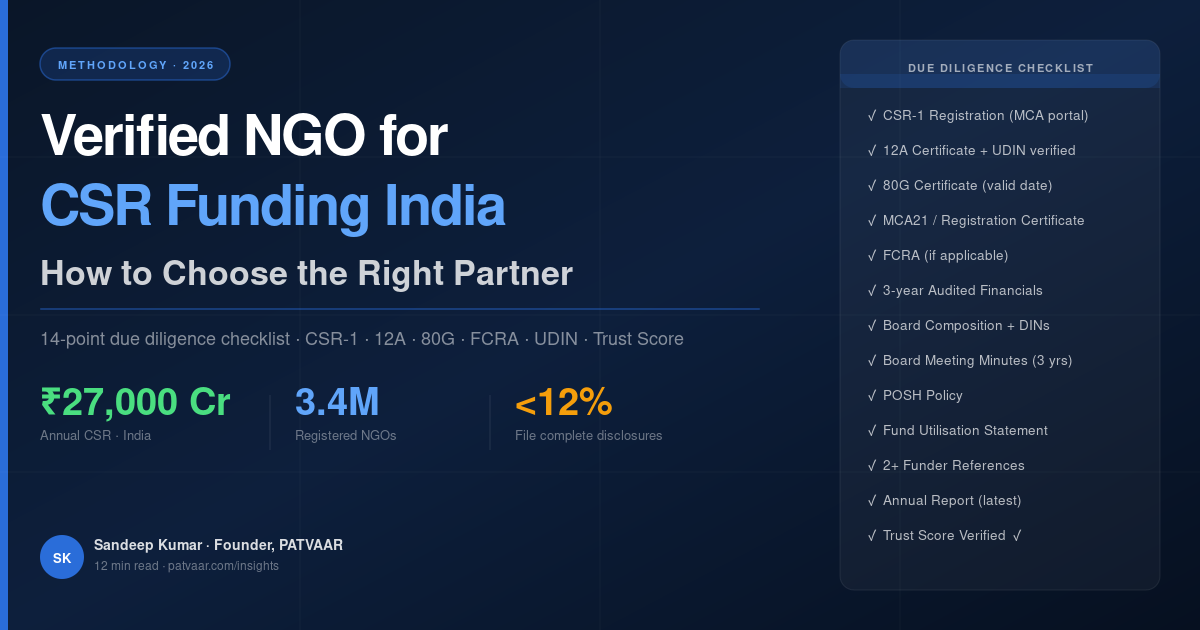
- Legal name and registration: do they exist, and do they match?
- Income-tax registration and approval: current, and the right name?
- NGO Darpan ID: looked up, matched, and not treated as an endorsement?
- FCRA, if foreign money: number checked on the official site?
- Latest audited accounts and annual report: signed, dated, consistent?
- Names compared across every document and the bank account?
- Evidence of work you can see: places, partners, people?
- Payment to the organisation's own account only?
- One-page record kept, with the date of the next check?
Frequently asked questions
How can I check if an NGO is genuine in India?
Ask for its legal registration, its income-tax registration and approval orders (the old 12A and 80G), its FCRA status if it takes foreign money, its NGO Darpan ID, and its latest audited accounts and annual report. Then check each one at the source and compare names across all of them. Finally, look for evidence that the work exists on the ground.
Does an NGO Darpan ID prove an NGO is genuine?
No. It shows that the organisation registered on the portal. The portal has said the ID is generated from information the organisation supplies and does not imply endorsement.
Where can I verify FCRA status?
On the FCRA website run by the Ministry of Home Affairs (fcraonline.nic.in). Check the registration number or prior-permission details there instead of relying on a PDF the NGO sends you.
Should I donate to a personal bank account or UPI ID?
No. Give to the organisation's own bank account, in its registered name. A request to pay a personal account, or to pay urgently by a link in a chat message, is a warning sign.
What does a PATVAAR Trust Score tell me?
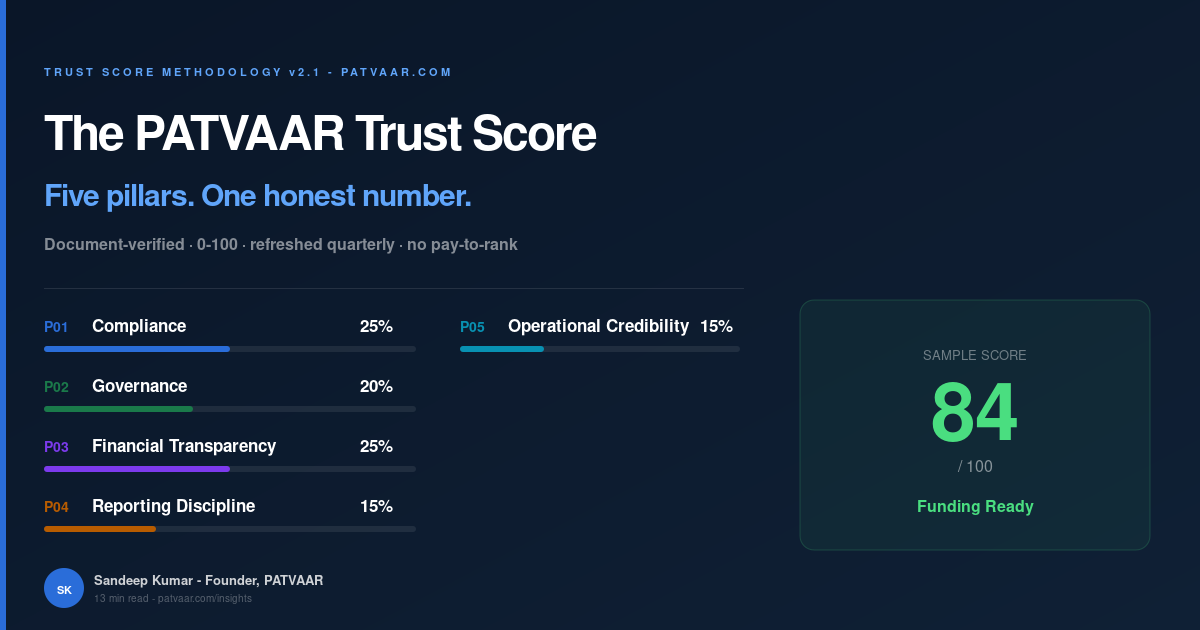
It is a composite of five pillars built from documents our reviewers examine and, where possible, official-source checks. It is one input to your decision, not a guarantee, and it is never affected by payments.
What if I think an NGO is not genuine?
Stop and do not pay. Write down what you were told and keep any messages. Report it to the relevant authority or to the platform where you saw the appeal, and, if you have paid, tell your bank promptly.
Sources
- NPO Darpan portal (NITI Aayog)
- NITI Aayog: Voluntary Action Cell
- FCRA online (MHA): Frequently Asked Questions
- Income Tax Department: Form No. 105 FAQs
- Income Tax e-Filing portal
- Ministry of Corporate Affairs
- Smile Foundation: How to verify an NGO before donating (an NGO's own guide)
Last reviewed on 8 November 2026 against the sources above. Rules change, so confirm the current position on the official site before you act. This article is general information, not legal or tax advice.
How PATVAAR verifies information
Our process has several layers. First, our verification team reviews every document an NGO uploads. Second, where the issuing department publishes a portal (for example the Ministry of Corporate Affairs, the Income Tax Department, the FCRA portal of the Ministry of Home Affairs or the ICAI UDIN portal), we cross-check the document against it for validity and for a match with the registered name, and we record the reviewer and the date. Third, registration numbers, UDINs and certificate details are checked online for authenticity wherever that is possible.
Where an item cannot be confirmed from an official source, it is recorded as a manual review, with written notes and a supporting evidence file. That file can be, for example, a declaration signed by the authorised signatory or the chartered accountant of the organisation. It is not shown as an official-portal verification. For project information, our team may, where the project details call for it, contact a sample of beneficiaries or check a project site. A Trust Score is published only when the required evidence has passed review, and payments never affect a score. Review typically takes three to seven working days once the documents are complete.
Read the details in our verification standards, the scoring methodology and the data sources.