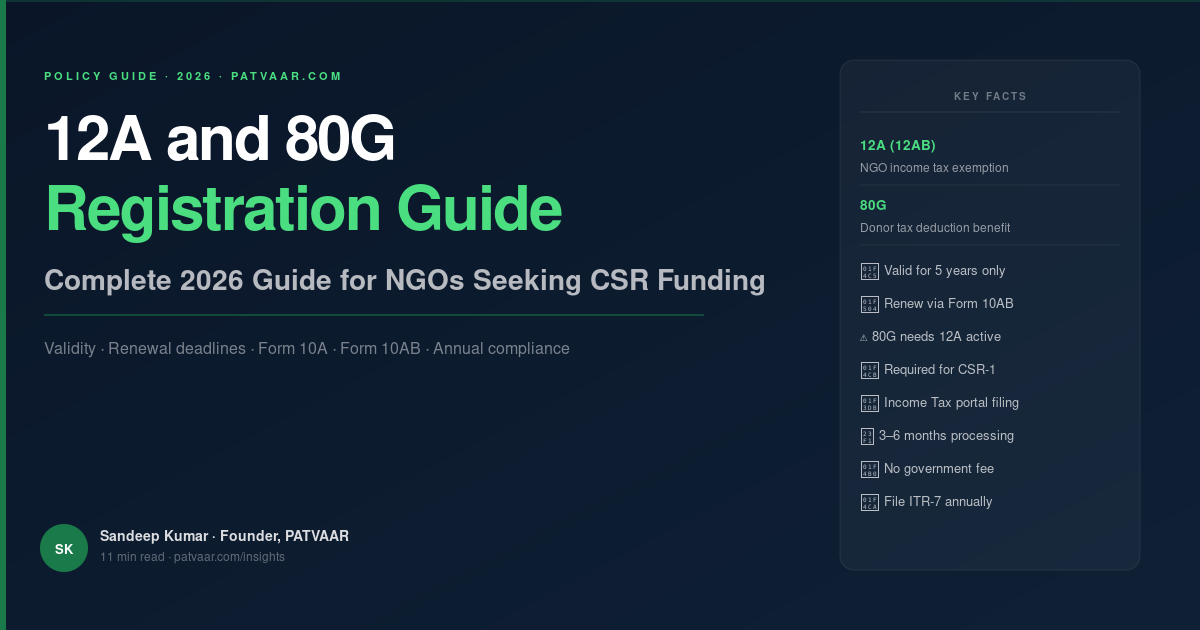
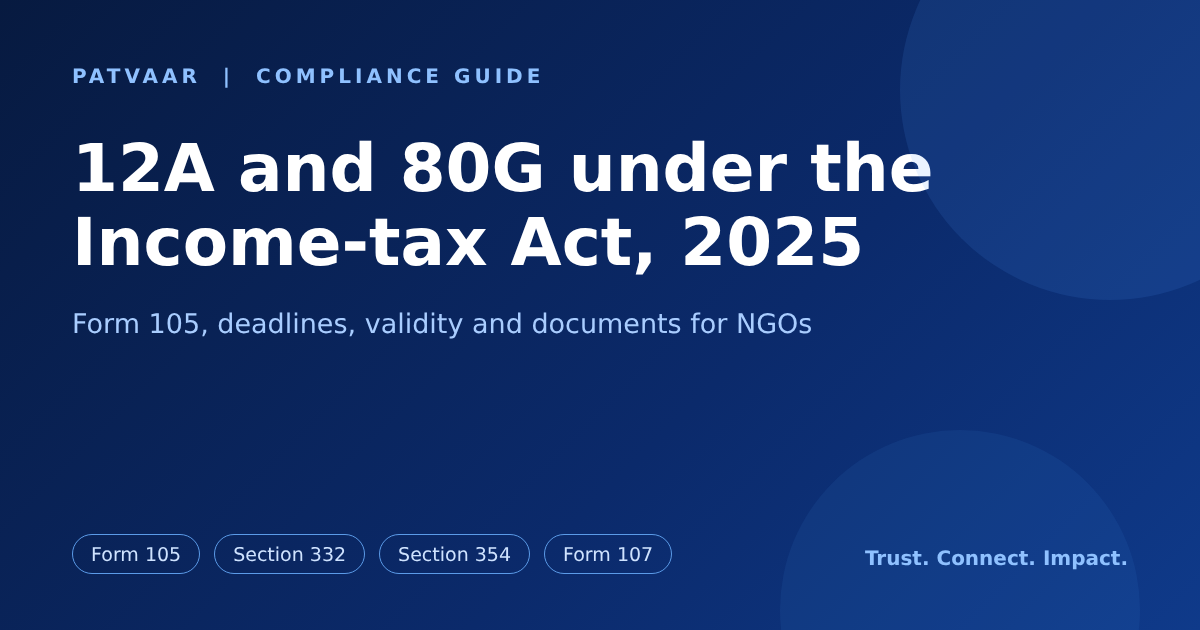
The short version. Nothing about the idea has changed: a charitable organisation still needs to be registered to enjoy the income-tax exemption, and still needs a separate approval before its donors can claim a deduction. What has changed is the paperwork. Under the Income-tax Act, 2025, both permissions are applied for on one form, Form No. 105, and the sections have new numbers. If your board, your auditor or your CSR contact still talks about "12A, 80G and 10AB", they are using the old names for the same two permissions.
This guide is based almost entirely on one document: the Income Tax Department's own FAQ on Form No. 105. We have kept to what that page says, quoted its numbers exactly, and marked the places where we are giving practical advice rather than reporting a rule. The FAQ itself contains a few typographical slips, and we point those out rather than quietly correcting them. Rules change, so read this as a map and check the source before you file anything.
Why NGOs still say "12A and 80G"
For years the two permissions had short names that everybody in the sector understood. "12A" meant the registration that lets a trust, society or Section 8 company claim exemption on its income. "80G" meant the approval that lets a donor deduct a donation. Funders, banks, grant portals and even some state governments built those names into their forms. A CSR due-diligence checklist from a few years ago will simply say "12A and 80G certificate: yes/no".
When a law is replaced, vocabulary lags behind. NGO staff, auditors and consultants will go on saying 12A and 80G for a long time, and that is fine in conversation. It becomes a problem when you are filling an actual application, or reading an actual order, because the section numbers, form numbers and rule numbers are different. The table below maps the old names to the new ones as the Income Tax Department's FAQ describes them.
| What it does | Under the 1961 Act | Under the 2025 Act |
|---|---|---|
| Regular registration of a non-profit (exemption of its income) | Section 12A(1)(ac) | Section 332(3) |
| Regular approval (donor deduction) | Section 80G(5)(vi) | Section 354(2) |
| Donations eligible for the donor | Section 80G | Section 133(1)(b)(ii) |
| Application form | Form 10AB | Form No. 105 (Income-tax Rules, 2026) |
| Rule that governs the application | Rules 11AA and 17A (1962 Rules) | Rule 181 (2026 Rules) |
| Order granting or refusing | Order under the relevant section | Form No. 107 |
One detail from the FAQ is worth noticing. The sections of the 2025 Act that the FAQ points to are described by table serial numbers (for registration, Sl. Nos. 2 to 7 of the table in section 332(3); for approval, Sl. Nos. 2 to 5 of the table in section 354(2)). Those serial numbers correspond to the situations we list further down. That is why the form asks you to pick a "section code" in Part B: the code tells the tax officer which situation you are in.
What Form 105 actually is
According to the FAQ, Form No. 105 is a common application. One form carries two requests: regular registration under section 332(3), and regular approval under section 354(2). You can ask for either or both. When you ask for both, the Principal Commissioner or Commissioner issues two separate orders in Form No. 107, one for registration and one for approval, and each can have a different outcome. The FAQ gives four possible outcomes for an order:
- the registration or approval is granted, and a 16-digit alphanumeric Unique Registration Number (URN) is issued;
- the application is rejected;
- the application is rejected and an existing registration or approval is cancelled;
- registration or approval is granted under one section code and refused under the other code in the same application.
The last outcome deserves attention. If you applied under two codes and one of them is refused, you will not get a single "approved" or "rejected" status; you will get a mixed result, and you need to read the order carefully to see which part was granted. We come back to this in the section on reading your order.
The form is filed electronically, to the jurisdictional Principal Commissioner or Commissioner, on the Income Tax e-Filing portal. The FAQ is explicit that offline filing is not permitted and that a valid PAN is mandatory. You cannot submit the form without a PAN.
Who has to file, and in which situation
The FAQ says filing is mandatory only for an applicant that wants regular registration or approval, the benefits that go with registration, or the donor deduction under section 133(1)(b)(ii). An organisation that is content to forgo those benefits is not forced to file. In practice, almost every NGO that wants institutional funding wants all three, so for most of the sector the question is not "do we have to file" but "which situation are we in, and by when".
Regular registration: six situations
The FAQ lists six situations for registration under section 332(3). The organisation must be a non-profit organisation under section 332(1) and meet the conditions in section 332(2) (the FAQ gives the example of being registered or incorporated in India for charitable or religious purposes). Then:
- Activities have commenced and you have never been registered under the earlier provisions (the FAQ lists sections 12A, 12AA, 12AB and 10(23C) of the 1961 Act) or under section 332 of the 2025 Act.
- You hold provisional registration and activities have commenced.
- Your provisional registration is about to expire and activities have not commenced.
- Your registration is about to expire (other than the case in point 3).
- Your registration became inoperative because of a regime switch under section 333.
- You are registered, but you have adopted or modified your objects in a way that no longer conforms to the conditions of registration.
Regular approval: four situations
Approval under section 354(2) is available to a registered non-profit (or a regimental or Non-public Fund of the armed forces) that wants donors to be able to claim the deduction under section 133(1)(b)(ii). The FAQ lists four situations: activities have commenced; provisional approval is held and activities have commenced; provisional approval is due to expire and activities have not commenced; or the approval period of a registered organisation is due to expire.
Notice the order of events. You need registration first, because approval is for a "registered" non-profit. If you are brand new, you will usually be on a provisional track for both, and you will need to move to regular status later. The deadlines below tell you when.
The deadlines, in one table
Time limits are where organisations most often get hurt. The FAQ sets them situation by situation:
| Your situation | Applies to | Deadline for Form 105 |
|---|---|---|
| Activities commenced, never registered under the listed provisions | Registration and approval | At any time during the tax year from which registration or approval is sought |
| Provisional status, activities have commenced | Registration and approval | Within six months of commencement of activities |
| Provisional status about to expire, activities not commenced | Registration and approval | At least six months before the provisional status expires |
| Registration or approval about to expire (any other case) | Registration and approval | At least six months before expiry |
| Registration became inoperative (regime switch, section 333) | Registration only | At any time during the tax year from which registration is to be made operative |
| Objects adopted or modified so they no longer conform | Registration only | Within thirty days of the adoption or modification |
Two of these are easy to miss. The six-month-before-expiry rule means the clock starts well before the date printed on your certificate. And the thirty-day rule for changed objects is short; boards sometimes amend a trust deed or memorandum for good reasons (to add a programme area, say) without realising that the amendment itself triggers a filing.
A worked illustration
This is a made-up example to show the arithmetic, not a real case. Suppose an NGO's regular registration runs out on 31 March 2028. The FAQ says to apply at least six months before expiry, so the last safe date is 30 September 2027. Working backwards from that, a sensible internal calendar would be: assemble the document pack by June 2027; have the auditor review the activity note by July; file in August, with a month of margin for portal problems, DSC or login issues, and a missing signature. If you file on 29 September, you have met the rule on paper but left no room for anything to go wrong.
The same logic applies to the thirty-day rule. If the board passes a resolution amending the objects on, say, the 3rd of a month, the thirty days are counted from the adoption or modification, not from the date the registrar stamps the amended document. Ask your adviser which date they treat as the trigger and write it down.
How long registration and approval last
The general rule in the FAQ is that regular registration or approval is valid for five tax years, starting from the tax year in which the application is made. There is also a longer period: if the applicant's total income, computed without taking Part B of Chapter XVII into account, did not exceed Rs 5 crore in each of the two preceding tax years, registration validity is ten tax years. The page actually prints "Rs 5 core", which is almost certainly a typo, but it is a typo in a figure that matters, so we recommend you check the provision itself and not rely on our reading or anyone else's.
Two practical points follow from this. First, validity is counted in tax years from the year of application, not from the date of the order. Read the validity statement on your own Form No. 107 and diarise the end date from there. Second, a longer validity period is not the same as less work: you still file annual returns and keep your books in order. The validity only tells you when you next have to apply.
What the order looks like, and how to read yours
Once you file, the Principal Commissioner or Commissioner must pass an order within six months from the end of the quarter in which the application was made. The order is in Form No. 107, and if it grants registration or approval, it carries the 16-character URN.
When the order arrives, do four things before you file it away:
- Check the name and PAN against your registration documents. A small spelling difference between the trust deed and the order will surface later, at the worst moment, in a funder's due-diligence check.
- Check which codes were granted. If you applied for both registration and approval, there are two orders. Make sure both say what you expected.
- Note the validity period and write the end date down. Put the six-month-before date in a shared calendar, not in one person's inbox.
- Keep the URN with your compliance records. Keep it handy, because it is the quickest way to point to the order.
Documents the FAQ lists
The FAQ lists attachments "as applicable", so not every applicant uploads all of them. The common ones are:
- a self-certified trust deed, or the instrument that created or established the applicant;
- self-certified proof of registration with the Registrar of Companies, Firms and Societies, or Public Trusts, as the case may be;
- self-certified FCRA 2010 registration, if you have one;
- self-certified copies of existing grant or approval orders under the earlier provisions, and any rejection or cancellation orders;
- self-certified annual accounts for the preceding years the organisation has existed, not more than three years;
- if you hold a business undertaking (section 344) or have income from a commercial activity (section 345), the accounts of that business for the same period, with an audit report in certain cases;
- documents showing adoption or modification of objects, where that is why you are filing;
- an order condoning delay, if one applies; and an explanation of the cause of delay if you are late;
- a detailed note on your activities.
The last item deserves more thought than most organisations give it. A "detailed note on activities" is where an officer forms a picture of what you actually do. Write it as a factual description: who you serve, where, what you do, and how you are funded, in plain language. Avoid promotional language and anything you cannot support from your own records. If the note says one thing and your accounts say another, you will be asked about it.
Withdrawing, correcting and re-applying
Three provisions in the FAQ are easy to overlook until you need them.
Withdrawal. An application can be withdrawn within seven days of filing. If you notice a serious error immediately, that window is useful.
Correction. If you picked the wrong section code or described your nature of activity wrongly, you can ask for a correction before the Form No. 107 order is passed, and the Principal Commissioner or Commissioner may allow it. The FAQ mentions "Form No 100AB" in this context, which looks like a typo for Form No. 105.
Re-application after cancellation. This is a one-time opportunity, available only after the first cancellation. It has to be filed within one month from the end of the month in which the cancellation order was passed, and only if the order rested solely on one of three grounds: you did not provide documents or information that was asked for; you did not use the opportunity of being heard; or you were ineligible because of the terms of your trust deed, which you have since modified. You must give reasons and an undertaking that no appeal is pending against the cancellation order, or that none will be filed. If you had appealed, you have to withdraw the appeal and upload proof of that. A re-application is treated as a fresh one.
If you are in this position, this is not a place for guesswork. Talk to a chartered accountant or an advocate who handles exemption matters.
The mistakes that cost NGOs the most time
The following is our own reading of how things tend to go wrong, not a list from the FAQ. We have drawn it from the deadlines and requirements above.
- Treating the expiry date as the deadline. The deadline for a renewal is at least six months earlier. Many organisations discover this when a funder asks for a "valid" certificate and they are inside the final six months.
- Changing objects without filing. A routine amendment to the trust deed or memorandum can trigger a thirty-day filing. Put a line in your board's procedure: any change to objects goes to the compliance lead the same week.
- Mismatched names. The name on the order, the PAN, the registration certificate, the bank account and the website should be identical. Small variations (Trust vs. Charitable Trust, abbreviations, a missing word) are the kind of thing that triggers extra questions when a funder compares documents.
- Leaving the activity note to the last day. It is the part of the application that needs the most thought and the least technical skill, and it is often written in a hurry.
- One person holding the login. If the e-Filing credentials sit with a single volunteer or a consultant who has moved on, a deadline can pass while you are trying to get access. Keep at least two authorised people.
- Assuming approval means a funder will fund you. Registration and approval are gate conditions, not selection criteria. They get you through the first screen; the funder's programme fit, your governance and your track record decide the rest.
What this means for different kinds of organisations
A new trust, society or Section 8 company
If you have only just started and have not begun activities, you are on the provisional track described in the FAQ. Your key dates are the six-month limits: within six months of commencing activities, or at least six months before the provisional status expires if you have not started. Record the date on which activities commenced. The FAQ notes that the undertaking in the form includes a declaration of that date, so it needs to be a date you can support.
An established NGO with an existing registration
Find your current order, read the validity statement, and put "six months before expiry" in the calendar now. If your order was issued under the 1961 Act, check how the FAQ's situations apply to you, in particular the case of a registration that became inoperative because of a regime switch under section 333. That is a question for your adviser, not something to guess from a summary.
An NGO that has changed its objects
Count thirty days from the adoption or modification. If the new objects no longer fit the conditions of registration, you need to file. Keep the board resolution and the amended document together.
A funder or CSR team reading someone else's certificate
Ask for the order, not a screenshot of an old certificate. Check the validity period against today's date. Check that the name matches the legal entity you are contracting with. And check whether the registration and the approval are both current; having one does not mean you have the other.
How PATVAAR treats these documents
On PATVAAR, an NGO uploads its registration and approval documents, and our review team looks at them against the official source where one is available. A document that has lapsed or does not match the organisation's name does not count towards a published Trust Score. Items that cannot be confirmed from an official source are recorded as manually reviewed or attested, and are not shown as officially verified. Payments and subscriptions never affect a score. You can read exactly how this works on the Trust Score methodology page and the verification standards page, and see where our data comes from on the data sources page.
If you are an NGO preparing your documents, the free registration walks you through what to upload. If you are a donor or a CSR team, the verified NGO registry shows organisations whose scores have been published, and the CSR funding guide explains how funders look at eligibility. PATVAAR does not collect donations and does not promise any tax outcome; a "Donate" link on a profile takes you to the NGO's own website.
For the two neighbouring compliance topics, see our guides to FCRA registration and prior permission and the NGO Darpan Unique ID, and our checklist for donors on how to check whether an NGO is genuine.
A closing checklist
- Find your current Form No. 107 order (or the older certificate). Note the URN, the name, the PAN and the validity.
- Calendar the date that is six months before expiry, and put a second reminder a month earlier.
- Confirm that your registration and your approval are both current, and which section codes they were granted under.
- Check that your name, PAN and registration documents match exactly.
- Make sure two authorised people can log in to the e-Filing portal.
- Keep the activity note updated every year, so that the next application starts from a current document.
- If your objects change, note the date and check the thirty-day rule.
- Read the source yourself: the Form No. 105 FAQ, and file through the Income Tax e-Filing portal.
Frequently asked questions
Is 12A still used under the Income-tax Act, 2025?
People still use the old names in conversation, but the Income Tax Department's Form No. 105 FAQ places regular registration of a non-profit under section 332(3) of the Income-tax Act, 2025 and regular approval under section 354(2). The application form for both is Form No. 105.
What is Form 105?
Form No. 105 is the common application for regular registration and regular approval under the 2025 Act. According to the FAQ, it takes the place of Form 10AB under the Income-tax Rules, 2026. If you apply for both at once, two separate orders in Form No. 107 are issued.
How long does registration or approval last?
The FAQ gives five tax years, counted from the tax year of the application. It also describes ten tax years where the applicant's total income did not exceed a stated limit in each of the two preceding tax years. The page prints that limit as "Rs 5 core", which looks like a typo for Rs 5 crore, so confirm it in the provision before relying on it.
When do I have to renew?
For registration or approval that is due to expire, the FAQ says to apply at least six months before the expiry date.
Can I withdraw a Form 105 application?
The FAQ says an application can be withdrawn within seven days of filing.
What if my application is rejected or my registration cancelled?
The FAQ describes a one-time re-application, only after the first cancellation, to be filed within one month from the end of the month in which the cancellation order was passed, and only on three narrow grounds. Talk to a professional before you rely on it.
Does PATVAAR promise that donors will get 80G deductions?
No. PATVAAR does not promise tax outcomes. Whether a donor can claim a deduction depends on the NGO's approval and on the donor's own circumstances. Ask the NGO for its current order and check the dates.
Sources
- Income Tax Department: Form No. 105 FAQs
- Income Tax Department (home)
- Income Tax e-Filing portal
- Income Tax Department: Section 12AB (1961 Act, historical)
Last reviewed on 8 November 2026 against the sources above. Rules change, so confirm the current position on the official site before you act. This article is general information, not legal or tax advice.
How PATVAAR verifies information
Our process has several layers. First, our verification team reviews every document an NGO uploads. Second, where the issuing department publishes a portal (for example the Ministry of Corporate Affairs, the Income Tax Department, the FCRA portal of the Ministry of Home Affairs or the ICAI UDIN portal), we cross-check the document against it for validity and for a match with the registered name, and we record the reviewer and the date. Third, registration numbers, UDINs and certificate details are checked online for authenticity wherever that is possible.
Where an item cannot be confirmed from an official source, it is recorded as a manual review, with written notes and a supporting evidence file. That file can be, for example, a declaration signed by the authorised signatory or the chartered accountant of the organisation. It is not shown as an official-portal verification. For project information, our team may, where the project details call for it, contact a sample of beneficiaries or check a project site. A Trust Score is published only when the required evidence has passed review, and payments never affect a score. Review typically takes three to seven working days once the documents are complete.
Read the details in our verification standards, the scoring methodology and the data sources.