Every year, Indian companies are legally required to spend thousands of crores on social good. Yet the organisations doing the most credible work on the ground — small and mid-sized NGOs with real impact — rarely see that money. Not because they are doing bad work, but because they cannot prove it in a language that corporate CSR teams understand.
This guide is written for those NGOs. If you have been doing meaningful work for years but keep getting passed over when CSR funds are distributed, this is the most important thing you will read this year.
We will cover every step: the legal requirements you must meet, how corporate CSR teams actually evaluate NGOs, what documents they ask for, how the shortlisting process works, and what separates the NGOs that consistently win mandates from those that consistently do not.
Understanding India's CSR Mandate — The Legal Foundation
Corporate Social Responsibility in India is not optional for large companies. Under Section 135 of the Companies Act 2013, any company with a net worth of Rs 500 crore or more, a turnover of Rs 1,000 crore or more, or a net profit of Rs 5 crore or more in the immediately preceding financial year must spend at least 2% of its average net profit of the preceding three years on CSR activities.
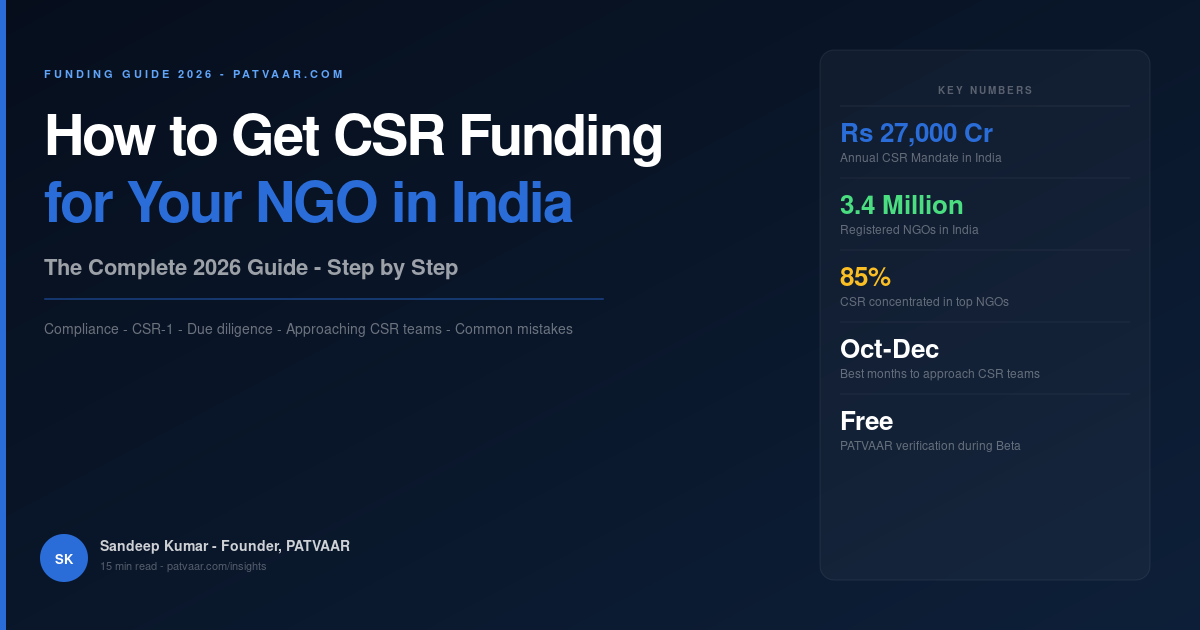
In FY2024-25, this translated to approximately Rs 27,000 crore in mandated CSR spending across India. That is not a small pool of money. The challenge is that it flows through a highly concentrated funnel — 85% of all CSR spending goes to a relatively small number of well-known, large NGOs that have existing relationships with corporate CSR teams.
The remaining 15% is contested by over 3.4 million registered NGOs in India. The competition is structural, not a reflection of the quality of work being done.
The core problem: A CSR manager at a large company receives 200+ grant applications per cycle. They have limited time to evaluate each one. Without a standardised credibility signal, they default to NGOs they already know. Your work quality is invisible to them without proper documentation.
Step 1 — Get Your Legal Compliance Stack in Order
Before you approach a single corporate CSR team, your compliance documentation must be complete and current. This is non-negotiable. CSR teams cannot legally transfer funds to NGOs that do not meet minimum compliance requirements, and their own finance and legal teams will flag any gaps immediately.
CSR-1 Registration (Mandatory Since April 2021)
Form CSR-1, filed on the MCA21 portal, is the single most important document for receiving corporate CSR funds. Without a valid CSR Registration Number (CRN), no company can legally transfer CSR funds to your NGO, regardless of how credible or established you are.
CSR-1 is a separate registration from your 12A, 80G, or FCRA. It specifically registers your NGO as an eligible implementing agency for corporate CSR. The application requires certification by a practising CA, CS, or CMA and is processed by the Registrar of Companies.
If you do not have CSR-1, stop reading this guide and apply immediately. Read our complete CSR-1 registration guide for the step-by-step process.
12A Certificate (Income Tax Exemption)
Your 12A certificate — now technically 12AB after the 2021 amendments — grants your NGO exemption from income tax on receipts and grants. Since 2021, 12A is valid for 5 years only and must be renewed before expiry. An expired 12A automatically invalidates your CSR-1 registration.
80G Certificate (Donor Tax Benefit)
The 80G certificate allows donors — including corporate CSR contributors — to claim a 50% deduction on their contribution against taxable income. While not all CSR contributions require 80G, having it significantly increases your attractiveness to funders. Like 12A, 80G is now valid for 5 years only.
For a detailed breakdown of 12A and 80G requirements, renewal deadlines and the filing process, read our complete 12A and 80G guide.
UDIN-Verified Audited Financials
For CSR funding above a certain threshold, funders will require 3 years of audited financial statements. Since 2019, all audit certificates must carry a Unique Document Identification Number (UDIN), generated on the ICAI UDIN portal. Financials without a valid UDIN are not accepted by most serious CSR teams.
Step 2 — Understand How Corporate CSR Teams Actually Work
Most NGOs approach CSR funding with a fundraising mindset — they write proposals, send emails, attend events, and hope for the best. This almost never works with serious CSR teams, because serious CSR teams do not work like individual donors.
The CSR Committee
Every company covered under Section 135 is required to have a CSR Committee comprising at least three directors, including at least one independent director. This committee approves the annual CSR policy, the list of implementing partners, and the spend plan. They typically meet once or twice a year and approve a shortlist of NGOs.
Getting onto that shortlist is the goal. A cold proposal sent to a generic email address will almost never reach this committee. You need to be on the radar of the CSR team — the executive staff who manage day-to-day implementation — before the annual planning cycle begins.
The Due Diligence Process
Before any company transfers funds, its CSR team conducts due diligence on the implementing NGO. The depth of this process varies, but for grants above Rs 10 lakh, expect the following:
- Verification of all compliance documents — CSR-1, 12A, 80G, MCA, FCRA if applicable
- Review of 3 years of audited financial statements
- Background check on trustees and key staff
- Site visit or field verification in some cases
- Reference checks with other funders
- Review of previous project reports and impact data
This process can take 4 to 12 weeks. Companies that run this process manually — which most still do — spend enormous resources on it. This is why PATVAAR exists: a verified NGO profile with a published Trust Score eliminates 90% of this work for the CSR team.
The Annual Planning Cycle
Most companies plan their CSR spend between January and March for the financial year beginning April 1. This means your outreach needs to happen between October and December. NGOs that approach CSR teams in June for that year's funding are almost always too late.
Mark these months in your calendar: October, November, December — this is when CSR planning decisions are being made.
Step 3 — Build a Credible NGO Profile
Even if your compliance is perfect and your timing is right, you still need to present your organisation in a way that gives a CSR manager confidence. This is where most NGOs fall short — not because their work is weak, but because their documentation does not reflect the quality of what they do.
Your Organisation Dossier
Every serious NGO needs a current organisation dossier — a 10 to 15 page document that covers:
- Organisation background, mission, legal structure and registration details
- Board of trustees and directors with photos, bios and DINs
- 3-year programme summary with beneficiary data and outcomes
- Financial summary — income, expenditure, surplus or deficit, programme spend ratio
- Key partnerships and past CSR funders with permission to name them
- Geographic reach and field presence
- Current projects and funding requirements
This document should be updated every year, no later than July, after the annual audit is complete.
Impact Data That Matters
CSR teams are evaluated internally on the outcomes of their grants. The NGOs they return to year after year are the ones that give them clean, credible, quantifiable impact data.
Numbers that matter to CSR teams: number of direct beneficiaries disaggregated by gender and geography; measurable outcomes such as students who passed, patients treated, livelihoods created; cost per beneficiary; and third-party verification of impact where possible.
Vague language — "we impacted thousands of lives" — is worse than no data. It signals that you are not measuring your work seriously.
Step 4 — Identify the Right CSR Opportunities
Not every company's CSR mandate is relevant to your work. Pursuing the wrong opportunities wastes your time and damages your credibility with CSR teams who see you as unfocused.
Schedule VII Focus Areas
Section 135 specifies that CSR spending must fall within the activities listed in Schedule VII of the Companies Act. These include education, healthcare, environment, rural development, gender equity, skill development, and several others. Your programmes must clearly align with one or more of these categories.
CSR-2 Filings — A Goldmine of Intelligence
Since FY2021-22, companies are required to file Form CSR-2 annually with the MCA, disclosing their CSR spend by project, sector, and implementing agency. This data is publicly available on the MCA portal and gives you a complete picture of which companies are funding which causes, in which geographies, and through which NGOs.
Use CSR-2 data to identify companies that have funded NGOs similar to yours in sectors and geographies where you work. These are your warmest leads.
Step 5 — Approach CSR Teams the Right Way
With your compliance in order, your profile built, and your target companies identified, you are ready to make contact.
Find the Right Person
Do not send cold emails to generic corporate addresses. Identify the CSR Head or Chief Sustainability Officer by name. LinkedIn is the most efficient tool for this. Industry events and sector-specific convenings are where you will meet these people in person.
A warm introduction through a common connection is worth ten cold emails. Invest in building relationships with people who can make introductions: community foundations, CSR consultants, impact investors, and other NGO leaders who already have relationships with corporate CSR teams.
Your First Communication
Your initial communication should be a brief, specific note — not a long proposal. Two paragraphs maximum: who you are, what you do, where you work, and why you believe there is a fit with their CSR priorities. Attach your organisation dossier. Ask for 20 minutes on a call.
The Proposal
Only send a full proposal when asked. When you do send one, keep it focused: problem statement, your solution, implementation plan, budget with cost per beneficiary, measurement framework, and your organisation's credentials.
The budget is where many NGOs lose deals. Keep programme-to-overhead ratios above 70:30. CSR teams are sensitive to overhead costs and will ask about them directly.
Step 6 — Build Long-Term Relationships, Not One-Time Grants
The NGOs that consistently receive CSR funding are not the ones with the best proposals. They are the ones that CSR managers trust — because they have delivered on previous grants, reported transparently, and made the funder look good internally.
Reporting That Builds Trust
Submit your project reports on time, every time. Include photos, beneficiary testimonials, financial utilisation certificates with UDIN, and measurable outcomes. Send quarterly updates even when they are not required. Make the CSR team's job easy.
The Renewal Advantage
Renewing a grant with an existing NGO partner is 10 times easier than approving a new one. The due diligence is lighter, the trust is established, and the reporting history provides proof of performance. Every first-time grant you receive is an opportunity to secure a 3-year partnership if you execute well.
How PATVAAR Changes This Equation
Everything described above — the compliance verification, the credibility assessment, the due diligence — currently happens manually, repeatedly, and inefficiently. A CSR team that works with 20 NGOs conducts the same verification exercise 20 times. An NGO that applies to 10 companies submits the same documents 10 times.
PATVAAR is built to solve this. When your NGO is verified on PATVAAR and your Trust Score is published, every compliance document has been verified against primary government sources, your Trust Score gives any funder an immediate credibility signal, and your profile is discoverable to all CSR teams on the platform.
Think of it as a CIBIL score for NGOs. One verification. One score. Trusted by all funders. During Beta, verification is completely free. Get your free Trust Score here.
Get your NGO CSR-ready in 7 days.
Get your PATVAAR Trust Score. Trust Score published within 7 working days. Free during Beta.
Common Mistakes NGOs Make When Applying for CSR Funding
Applying to too many companies at once. Focus on 5 to 8 companies that are a genuine fit. Put real effort into each relationship.
Letting compliance documents expire. An expired 12A or 80G is an immediate disqualification. Set calendar reminders 6 months before every expiry date.
Weak financial management. A high overhead ratio, unexplained variances in financials, or missing UDIN certifications are red flags that end conversations quickly.
No impact data. If you cannot tell a funder exactly how many people your programme reached and what changed for them, you are not ready to receive CSR funding at scale.
Approaching at the wrong time. CSR planning happens between October and March. June outreach rarely succeeds.
Treating CSR like charity. Corporate CSR is a compliance and reputational exercise for companies. Treat every interaction as a professional B2B relationship, not a charity appeal.