In short: Yes, a young NGO can approach CSR teams, but not by the same door an established NGO uses. The three-year track record in the CSR Rules applies to one route. Your job is to be fully registered, then choose a route that fits an organisation that is still building its history. Nobody can promise you a grant.
1. What the Rules actually say
Rule 4(1) of the CSR Rules lists the ways a company can carry out CSR. It can do the work itself, or through one of these: (a) a Section 8 company, trust or society established by the company; (b) one established by the Central or a State Government; (c) an entity set up under an Act of Parliament or a State legislature; or (d) a Section 8 company, registered public trust or registered society with the required tax status that has "an established track record of at least three years in undertaking similar activities".
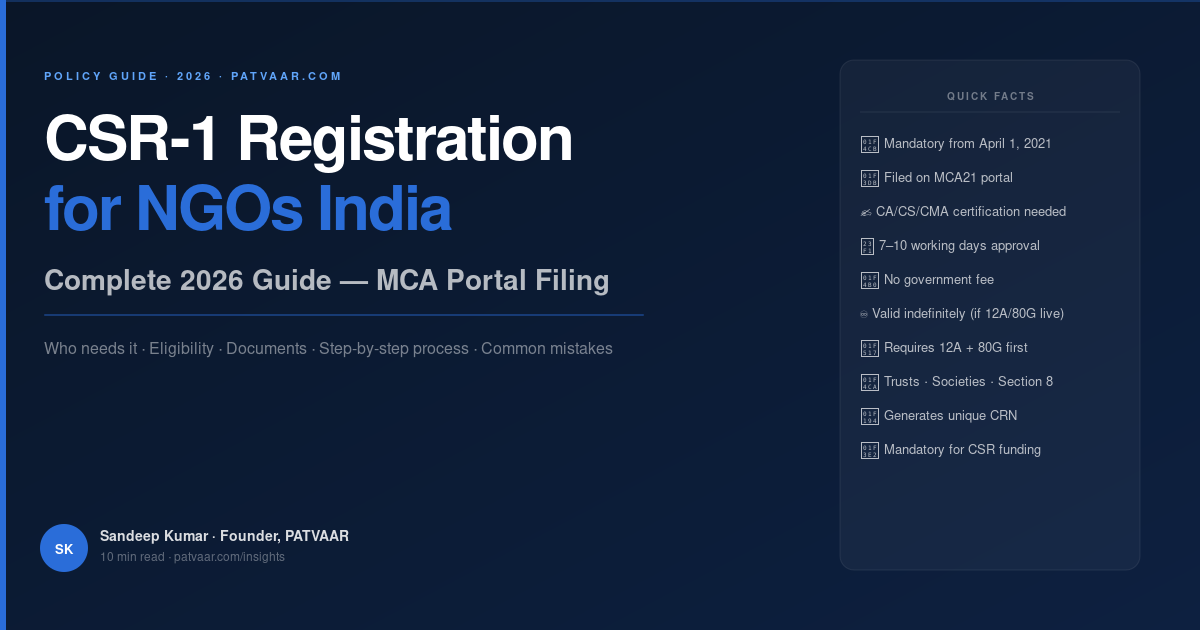
So the three-year condition sits in clause (d), the route most NGOs mean when they ask how to get CSR funding. Rule 4(2) separately requires an entity covered by Rule 4(1) to register on the MCA portal by filing Form CSR-1.
What the Rules do not do is describe how a company should treat a young NGO that works under an established implementing agency. That is the company's decision, which is why you should ask each CSR team directly. The 2026 amendment (G.S.R. 415(E), 27 May 2026) added a Social Stock Exchange route in Rule 4A and did not change Rule 4 or the three-year condition.
2. Before any route: the basics must be in place
Whether your NGO is three months or three years old, a company cannot move without the basic papers. Expect to need:
- Registration as a trust, society or Section 8 company (see how to register an NGO).
- 12A and 80G. New NGOs can apply for provisional registration, so you do not have to wait three years to start.
- CSR-1 registration on the MCA portal.
- A Darpan unique ID. The law does not name it in Rule 4, but most CSR teams ask for it.
If one of these is missing, fix it first. A proposal sent without them is usually put aside.
3. Route one: become a ground partner of an established agency
Many CSR projects are led by an implementing agency that already has the track record and the CSR-1 registration. That agency can bring in a smaller NGO to do the field work. The money and the compliance with the company stay with the lead agency. You deliver on the ground and report.
- What you gain: funded work, and your first documented history: field reports, photographs, attendance records and utilisation statements you produce yourself.
- What to insist on: a written agreement before you start, your exact role, the reporting format and dates, and when and how you are paid. Verbal understandings fall apart in audits.
- What to remember: the company and the lead agency decide whether they accept a partner. The lead agency answers to the company for how the money is used.
4. Route two: look at companies with smaller CSR budgets
Under section 135(9), a company whose CSR spend is ₹50 lakh or less does not need a CSR committee. The Board performs the committee's functions. At the standard 2% of average net profit, that is roughly a company with average net profit of up to ₹25 crore. In such companies, a proposal can reach the decision-makers with fewer steps in between.
That does not make the decision automatic, and the budget is smaller. Match your ask to the budget: a focused project in a place the company already operates is more realistic than a large programme.
5. Route three: a multi-year proposal at the right time
The Rules define an ongoing project as a multi-year project with a timeline not exceeding three years, excluding the year it starts. A two to three year plan with clear year-wise targets fits that definition and shows a company you are thinking beyond a single event. Unspent money on an ongoing project goes into the company's Unspent CSR Account within 30 days of year end, so a company has a reason to commit to projects it can track year by year.
On timing, the law sets no date. In the experience of PATVAAR's founder, October to March has worked best, because many CSR teams are finalising commitments in the second half of the financial year. Treat that as practice, and ask each team when its cycle closes. See also how to write a CSR proposal that gets funded.
6. What nobody can promise you
No route guarantees funding. Be careful with anyone who promises CSR funds for a fee, or who offers to "arrange" a CSR registration number. CSR-1 is filed by the NGO and certified by a practising CA, CS or Cost Accountant. Companies fund NGOs they can trust, so the real work is showing that every rupee is traceable. Read what CSR teams check and why NGOs with all the papers still do not get funded.
7. A realistic first year
- Months 1 to 3: registration, 12A and 80G, CSR-1, Darpan, a bank account in the NGO's name, a simple accounts system.
- Months 3 to 6: one small project or a ground-partner pilot, documented from day one.
- Months 6 to 12: approach a few companies whose themes and locations match your work, with a short proposal that includes the documents and reports you now have.
Where PATVAAR fits
PATVAAR reviews the documents an NGO uploads and publishes a Trust Score, so a young NGO can show its papers in one place. It does not promise funding. Create your NGO profile or browse live grants and CSR funding calls.
Frequently asked questions
Can a three-month-old NGO get CSR funding?
The CSR Rules ask for a three-year track record on one route: a company funding an NGO directly (Rule 4(1)(d)). A young NGO is not automatically shut out, because that is one of several routes. Founders approach CSR teams through other routes, such as working as a ground partner of an established implementing agency, but it depends on each company and nothing is guaranteed.
Does the three-year rule apply to every CSR route?
No. Rule 4(1) lists four ways a company can carry out CSR. The three-year track record sits in clause (d). The other clauses cover entities set up by the company itself, by the Government, or under an Act of Parliament or a State legislature.
What should a new NGO have in place before approaching a CSR team?
Registration as a trust, society or Section 8 company, 12A and 80G (new NGOs can apply for provisional registration), CSR-1 registration on the MCA portal, and a Darpan unique ID, which most CSR teams ask for.
Do companies with a small CSR budget have a CSR committee?
Not if the amount to be spent is ₹50 lakh or less. Section 135(9) says the committee requirement does not apply and the Board of Directors performs its functions.
When is the best time to send a CSR proposal?
The law sets no date. In the experience of PATVAAR's founder, October to March works well because many CSR teams are finalising commitments in the second half of the financial year. Ask each team when its cycle closes.
Sources
- Companies (Corporate Social Responsibility Policy) Rules, 2014: Rule 4 (current text)
- Companies Act, 2013: Section 135, Corporate Social Responsibility
- Companies (CSR Policy) Amendment Rules, 2026 (G.S.R. 415(E), 27 May 2026): adds Rule 4A, does not amend Rule 4
Last reviewed on 16 November 2026 against the sources above. Rules change, so confirm the current position on the official site before you act. The routes in sections 3 to 5 come from field experience, not from the text of the Rules. This article is general information, not legal or tax advice.
Related guides
Related guides