Most CSR proposals are rejected in the first ninety seconds. Not because the work is weak, but because the proposal fails to answer the three questions every CSR manager asks before reading past the first page. This guide walks you through exactly how to write a CSR proposal that survives that ninety-second test and moves to the shortlist. It is based on how CSR teams actually read, evaluate, and reject proposals in India.
A good CSR proposal is not a grant application in the traditional sense. It is a business case. The company giving you money has a board to answer to, a Schedule VII obligation to meet, and an annual report to publish. Your proposal needs to make their job easier, not harder. Once you understand that, everything about how you write changes.
Why Most CSR Proposals Fail
Before we get to what works, it is worth understanding why proposals get rejected. After reviewing how CSR teams across India evaluate incoming proposals, the same patterns appear again and again.
The first reason is that proposals are written from the NGO's perspective, not the funder's. They open with the organisation's history, mission, and founder's vision. A CSR manager does not care about any of that in the first read. They care about whether your project fits their focus area, whether you can deliver, and whether funding you carries reputational risk.
The second reason is the absence of measurable outcomes. A proposal that says it will "empower women" or "improve education" without specifying how many people, in what way, measured by what metric, over what timeline, gives the CSR team nothing to take to their board.
The third reason is credibility gaps. If the proposal does not establish, early and clearly, that the NGO is compliant, verified, and capable of handling the grant size requested, the CSR manager assumes risk. And CSR managers are paid to avoid risk.
The Three Questions Every CSR Manager Asks
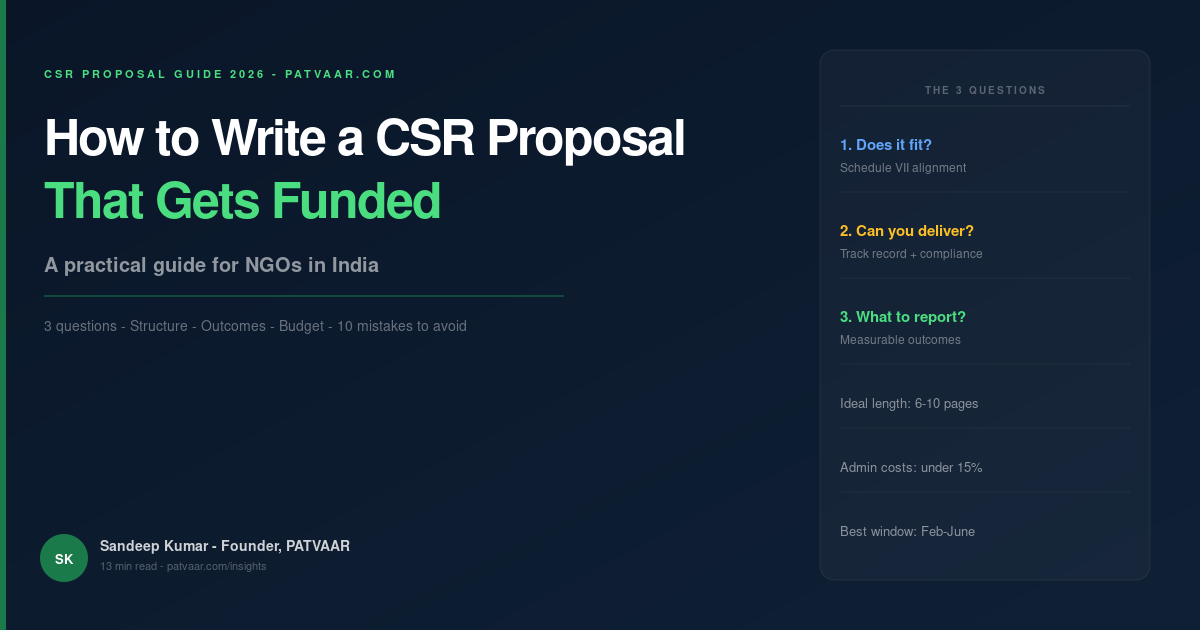
Every CSR proposal is evaluated against three questions. If your proposal answers all three clearly in the first page, you move forward. If it does not, you are rejected regardless of how good your actual work is.
Write your entire proposal with these three questions in mind. Every section should answer at least one of them. If a paragraph does not help answer any of the three, cut it.
The Structure of a Winning CSR Proposal
A CSR proposal should be between six and ten pages. Longer than that and it does not get read fully. Here is the structure that works, section by section.
Section 1 — Executive Summary (Half a Page)
This is the most important section and the one most NGOs get wrong. The executive summary should answer all three questions in under 200 words. It must contain: what the project does, where, for how many beneficiaries, what measurable outcome it will achieve, how much funding is requested, and which Schedule VII category it falls under.
A CSR manager reads this first. If it does not immediately make sense, they stop. Write it last, after the rest of the proposal is done, so it reflects the strongest version of your case.
Example executive summary opening: "This proposal requests Rs 45 lakh to deliver foundational literacy to 2,400 children across 30 government primary schools in Nuh district, Haryana, over 18 months. Independent assessment will measure reading fluency gains. The project aligns with Schedule VII Clause (ii) — promotion of education."
Section 2 — The Problem (One Page)
State the specific problem you are solving, backed by data. Not "India has an education crisis" but "In Nuh district, only 28% of Class 5 children can read a Class 2 text, against a national average of 50.3%, according to ASER 2024." Specific, sourced, local. This shows you understand the problem at the level of detail that justifies intervention.
Cite credible sources — government surveys, the National Family Health Survey, ASER, NSSO data, district-level statistics. Avoid citing your own internal surveys as the primary evidence; CSR teams discount self-generated data.
Section 3 — Your Solution (One to Two Pages)
Describe exactly what you will do. The activities, the methodology, the delivery model. Be concrete. A CSR manager should be able to picture the project running. Include the implementation timeline with milestones, the geographic scope with specific locations, and the delivery mechanism.
This is where you demonstrate that your approach is proven, not experimental. If you have run this model before, say so with results. If it is based on an established methodology, name it. CSR teams prefer proven models over innovative-but-untested ones, because proven models carry less risk.
Section 4 — Measurable Outcomes (One Page)
This section wins or loses the proposal. Define your outcomes using a clear framework: outputs (what you deliver), outcomes (what changes), and impact (the long-term effect). For each, specify the metric, the baseline, the target, and how you will measure it.
The CSR manager will lift these numbers directly into their board presentation. Make them clean, defensible, and measurable by a third party. Vague outcomes are the single most common reason strong NGOs lose to weaker ones with sharper proposals.
Section 5 — Budget (One Page)
Present a clear, itemised budget. Break it into programme costs and administrative costs, and keep administrative costs reasonable — ideally under 15%. Show the cost per beneficiary; CSR teams use this to compare proposals. A clean cost-per-beneficiary number that compares well against alternatives is a strong signal.
Be transparent about co-funding. If other funders are supporting parts of the project, say so. CSR teams view co-funding positively — it signals that others have already done diligence and chosen to back you.
Section 6 — Credibility and Compliance (One Page)
This section answers the second question: can you deliver? Include your registration details, 12A and 80G status, CSR-1 registration number, years of operation, and a brief track record with specific past results. If you hold a verified Trust Score, lead with it.
List your key team members with relevant experience. Mention your financial systems and audit history. The goal is to remove every reason a CSR manager might have to worry that funding you is risky.
The Single Biggest Differentiator: Verified Credibility
Here is what separates proposals that get funded from those that do not, beyond the writing itself. The CSR manager has to trust that you are who you say you are, that your compliance is current, and that your past results are real. Most proposals ask the funder to take all of this on faith.
The proposals that win are the ones where credibility is independently verifiable. When a CSR manager can check your registration, your compliance status, your financial track record, and your verification tier without having to call you and request documents, you have removed the single biggest source of friction in the funding decision.
This is precisely the problem PATVAAR solves. A verified Trust Score gives CSR teams an independent, instantly checkable credibility signal. Instead of writing three paragraphs trying to convince a funder you are trustworthy, you reference your Trust Score and let the verification speak for itself. Read our guide on how to get CSR funding for your NGO for the full picture of what funders look for.
Ten Common Mistakes That Kill CSR Proposals
Even well-structured proposals fail on avoidable mistakes. Here are the ten that come up most often.
How to Tailor a Proposal to a Specific Company
A generic proposal sent to fifty companies performs worse than a tailored proposal sent to five. Before writing, research the company's CSR policy, which is publicly available in their annual report and on their website. Identify their focus areas, their preferred geographies, and the kinds of projects they have funded before.
Then align your proposal to what you find. If a company has historically funded education in Maharashtra, and you run an education programme in Maharashtra, lead with that alignment. Reference their existing CSR priorities. Show that you have done your homework. This signals seriousness and dramatically increases your odds.
Companies also have CSR cycles. Most finalise their CSR budgets and partner selections in the first quarter of the financial year, between April and June. Submitting in February or March, before the new budget is allocated, positions you ahead of the rush.
The Follow-Up: What Happens After You Submit
Submitting the proposal is the beginning, not the end. Most NGOs submit and wait. The ones that get funded follow up professionally. Send a brief, polite follow-up two weeks after submission, offering to answer questions or provide additional information.
If a CSR team expresses interest, they will conduct due diligence. This is where your compliance documents, financial records, and verification get scrutinised. Have everything ready before you submit, so that when the diligence call comes, you can respond within hours, not days. Our NGO due diligence checklist walks through exactly what CSR teams examine at this stage.
A Proposal Checklist Before You Send
Before submitting any CSR proposal, run through this checklist. If you cannot tick every box, the proposal is not ready.
How PATVAAR Strengthens Your CSR Proposals
A strong proposal opens the door. A verified Trust Score keeps it open. When you reference your PATVAAR Trust Score in your credibility section, the CSR manager can independently verify your compliance, financial track record, and operational history in seconds — without waiting for you to email documents.
For NGOs listed on PATVAAR, CSR teams browsing the registry can find you proactively, filtered by sector and geography, with your credibility already established. That means some funding conversations begin with the funder reaching out to you, rather than you sending cold proposals. Verification is free during Beta and your Trust Score is published within seven working days. Get your free Trust Score here.
Make every CSR proposal carry verified credibility.
Get your PATVAAR Trust Score. Free during Beta. Published in 7 days.
Frequently Asked Questions
How long should a CSR proposal be?
Between six and ten pages. Longer proposals rarely get read fully. The executive summary should fit in half a page and answer the three key questions a CSR manager asks before reading further.
What is the most important section of a CSR proposal?
The measurable outcomes section. CSR teams lift these numbers directly into their board presentations and annual reports. Vague outcomes are the single most common reason that otherwise strong NGOs lose to better-written proposals.
What administrative cost percentage is acceptable in a CSR proposal?
Keep administrative costs under 15% of the total budget. Anything above 20% raises immediate concern with CSR teams and can lead to rejection regardless of the quality of the programme.
When is the best time to submit a CSR proposal in India?
Between February and June. Most companies finalise their CSR budgets and partner selections in the first quarter of the financial year. Submitting before the new budget is allocated positions you ahead of the rush.
Should I send the same proposal to multiple companies?
No. Generic proposals sent widely perform worse than tailored proposals sent to a few well-researched companies. Align each proposal to the specific company's CSR focus areas, preferred geographies, and past funding history.
What makes a CSR proposal credible to funders?
Independently verifiable credibility. Current compliance (12A, 80G, CSR-1), a clean financial track record, and third-party verification such as a PATVAAR Trust Score. When a CSR manager can verify your claims without contacting you, you remove the biggest source of friction in the funding decision.
Do I need CSR-1 registration to submit a CSR proposal?
Yes. Since April 2021, CSR-1 registration with the MCA is mandatory for any NGO to receive CSR funds. Without it, no company can legally fund you, regardless of how strong your proposal is.
How do I measure outcomes for a CSR proposal?
Use a three-level framework: outputs (what you deliver, like children enrolled), outcomes (what changes, like reading fluency gains), and impact (the long-term effect). For each, specify the metric, baseline, target, and measurement method, ideally with third-party assessment.