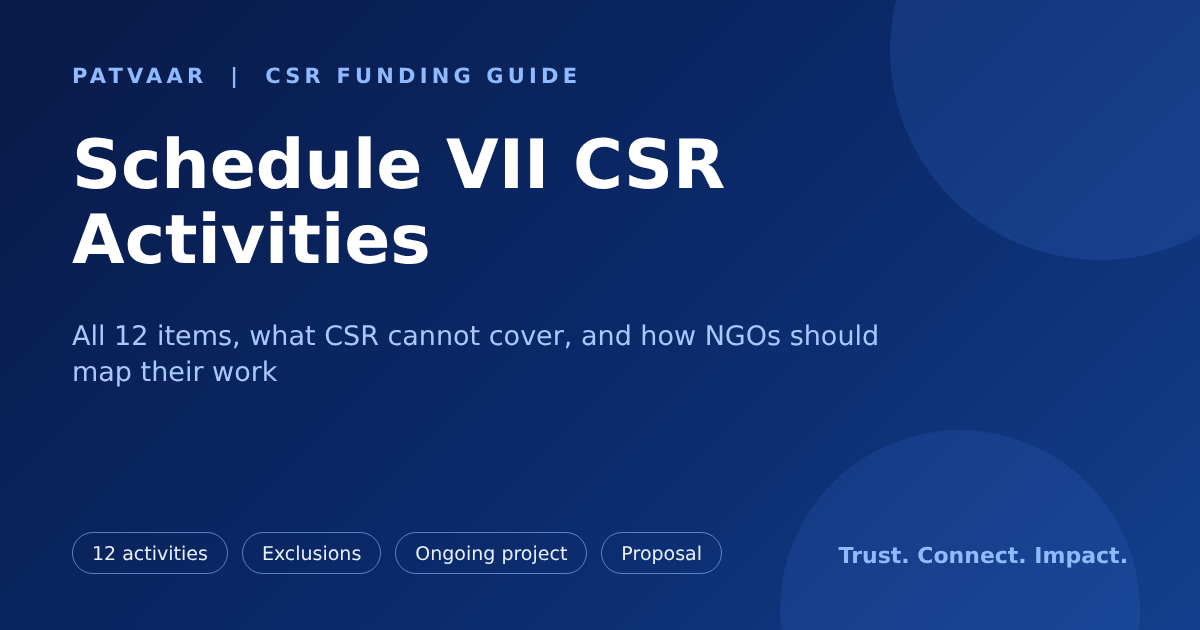
In short: Schedule VII of the Companies Act, 2013 lists the twelve kinds of activity a company may include in its CSR policy. A CSR team can only fund work that fits one of them, so the first step of any CSR proposal is to name the Schedule VII item your project falls under.
1. What Schedule VII is
Section 135 requires eligible companies to spend a share of profit on CSR. Schedule VII is the list of "activities which may be included by companies in their Corporate Social Responsibility policies". The Ministry of Corporate Affairs said in General Circular No. 21/2014 that the entries must be interpreted liberally so as to capture the essence of the subjects listed. That gives some room, but a company will still ask which item your project belongs to.
2. The twelve items in plain words
- Hunger, poverty, health and water: eradicating hunger, poverty and malnutrition, health care including preventive health care, sanitation, and safe drinking water. See CSR funding for healthcare.
- Education and livelihoods: promoting education, special education, employment-enhancing vocational skills and livelihood enhancement. See education and skill development.
- Gender and inclusion: gender equality, empowering women, homes and hostels for women and orphans, old-age homes and day care centres, and reducing inequalities faced by socially and economically backward groups.
- Environment and animal welfare: environmental sustainability, ecological balance, flora and fauna, animal welfare, agroforestry, conservation of natural resources and the quality of soil, air and water. See environment and water.
- Heritage, art and culture: protecting national heritage, art and culture, restoring historic buildings and sites, setting up public libraries, and promoting traditional arts and handicrafts.
- Armed forces veterans: measures for armed forces and paramilitary veterans, war widows and their dependents.
- Sports: training to promote rural sports, nationally recognised sports, and Paralympic and Olympic sports.
- Government relief funds: contributions to the Prime Minister's National Relief Fund, PM CARES Fund or another central government fund for the welfare of Scheduled Castes, Scheduled Tribes, other backward classes, minorities and women.
- Science and technology: contributions to incubators and to research and development projects in science, technology, engineering and medicine funded by the central or state government, and to public-funded universities and national research bodies working towards the Sustainable Development Goals.
- Rural development: rural development projects. See rural and agriculture.
- Slum area development: work in an area declared a slum by the central or state government or another competent authority.
- Disaster management: relief, rehabilitation and reconstruction.
3. What does not count as CSR
Since the 2021 amendment, the definition of CSR in Rule 2(1)(d) excludes:
- activities in the company's normal course of business;
- activities carried out outside India, except training Indian sportspersons representing a State, a Union Territory or India internationally;
- contributions, directly or indirectly, to a political party;
- activities that benefit the company's employees;
- sponsorship activities done to market the company's products or services; and
- activities done to meet another statutory obligation under Indian law.
A proposal that looks like marketing, staff welfare or a legal duty the company already has will be set aside.
4. How an NGO should use the list
- Name one primary item. Say in the first paragraph of your proposal which Schedule VII item the project falls under. Mention a second only if it is genuinely part of the work.
- Use the Schedule's own words. A CSR team has to record the item in its report, so make that easy.
- Match the company's themes. Most companies fund only a few items. Read their CSR policy and apply where your item is on the list.
- Do not stretch. A programme that does not fit an item is better described honestly than forced into one.
- Plan the duration. A multi-year project of up to three years counts as an "ongoing project" under Rule 2(1)(i), which suits multi-year proposals. See how young NGOs approach this.
Typical matches: a free school-readiness class falls under item (ii), a health camp under item (i), a tree plantation and water conservation project under item (iv), and a village livelihood programme under items (ii) or (x). The company makes the final call.
Where PATVAAR fits
PATVAAR groups CSR funding by sector so you can see what companies fund in your area. Read how to get CSR funding and how to write a CSR proposal, browse CSR funding by sector, or create your NGO profile.
Frequently asked questions
What is Schedule VII of the Companies Act?
Schedule VII lists the activities that a company may include in its Corporate Social Responsibility policy. It has twelve items, from hunger, health and education to rural development, slum area development and disaster management.
Can a company fund any activity as CSR?
No. CSR spending has to relate to an activity in Schedule VII, and the CSR Rules exclude some things outright, such as normal business activities, political contributions, benefits only for employees, sponsorship for marketing, and activities outside India.
Does the MCA read Schedule VII strictly?
In General Circular No. 21/2014 (18 June 2014), the Ministry of Corporate Affairs said the entries in Schedule VII must be interpreted liberally so as to capture the essence of the subjects listed. A company will still want to see which item your project falls under.
Can CSR money be spent outside India?
Generally no. The CSR Rules exclude activities carried out outside India, except training of Indian sportspersons representing a State, a Union Territory or India internationally.
What is an ongoing project under the CSR Rules?
A multi-year project undertaken by a company in fulfilment of its CSR obligation with a timeline not exceeding three years, not counting the financial year in which it began. Rule 2(1)(i) also covers a project not first approved as multi-year whose duration the Board extends beyond one year with reasonable justification.
Sources
- Companies Act, 2013: Schedule VII (activities which may be included in CSR policies)
- Companies Act, 2013: Section 135, Corporate Social Responsibility
- Companies (Corporate Social Responsibility Policy) Amendment Rules, 2021 (G.S.R. 40(E), 22 January 2021)
- MCA General Circular No. 21/2014 (18 June 2014)
Last reviewed on 16 November 2026 against the sources above. The twelve items are summarised in plain words, so read the Schedule itself for the exact wording. Rules change, so confirm the current position on the official site before you act. This article is general information, not legal or tax advice.