FCRA registration at a glance
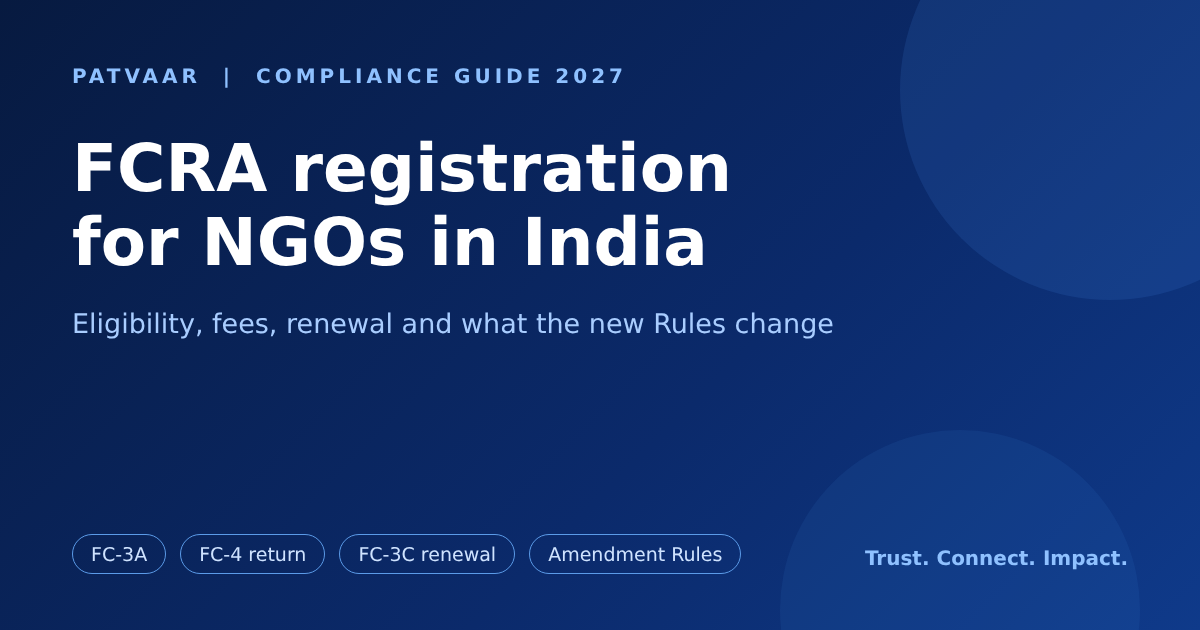
- Who needs it: any NGO that wants to accept foreign contribution under the Foreign Contribution (Regulation) Act, 2010. Domestic CSR money does not need FCRA.
- Eligibility in short: normally three years in existence, reasonable activity, and at least Rs 10 lakh spent over the last three years excluding administrative expenditure (FCRA FAQ).
- Validity: five years, renewed through Form FC-3C within the last six months of validity.
- Every year: Form FC-4 by 31 December, even when no money came in.
- Newest change: the FCRA Amendment Rules, 2026 (22 June 2026) and a pending Amendment Bill. Both are explained below.
I run PATVAAR and I review NGO documents myself, so I see how often FCRA is misunderstood. Some founders think it is needed for every grant. Others do not realise that it comes with yearly obligations that can end the registration if they are missed. This guide explains what FCRA covers, who can apply, how the process works, what the latest Rules changed, and what you must do after you are registered.
Operating without registration, or breaching the Act after you have it, can bring penalties well beyond a rejected form. Treat it as a compliance system, not a certificate.
What FCRA is and who needs it
The Foreign Contribution (Regulation) Act, 2010 regulates the acceptance and use of foreign contribution by associations, individuals and companies in India. It is administered by the Ministry of Home Affairs, which publishes registration details and annual returns on the FCRA portal. The aim of the Act is to keep foreign money from influencing public life or national interest.
The practical test is simple. If money, goods or securities come to your NGO from a foreign source, you need FCRA registration or prior permission before you accept them. If every rupee comes from Indian sources, you do not.
Do not mix up the two. FCRA is for foreign contribution only. If your funding comes from Indian companies' CSR budgets, you need CSR-1, 12A and 80G, not FCRA. See our guide to getting CSR funding and our overview of NGO funding sources in India.
What counts as foreign contribution
Foreign contribution is a donation, delivery or transfer of currency, articles or securities from a foreign source. A foreign source includes:
- foreign governments and their agencies;
- international and multilateral agencies;
- foreign companies, trusts and foundations;
- foreign citizens, including people of Indian origin who hold a foreign passport;
- in some situations, an Indian company that is controlled by foreign shareholders.
A citizen of India who lives abroad is not a foreign source just because of the address. OCI cardholders hold foreign citizenship, so treat them as foreign sources and confirm doubtful cases with the FCRA wing. Money earned by your NGO from services to a foreign client is a separate question, so ask before you assume it is outside the Act.
Indian subsidiaries of foreign companies are the grey area. Whether their CSR money counts as foreign contribution depends on the shareholding and control, so take written advice before you rely on it.
Registration, prior permission or neither
- Registration lets you receive foreign contribution from many sources for your stated purposes, for five years at a time.
- Prior permission is for one specific contribution from one specific source for one purpose, for organisations that do not qualify for registration yet.
- Neither is right if you only take domestic funds.
We compare the two routes point by point in FCRA registration vs prior permission.
Who can apply for FCRA registration
As the FCRA FAQ describes it, an association should:
- have a definite cultural, economic, educational, religious or social programme;
- normally be in existence for at least three years;
- have undertaken reasonable activity in its chosen field; and
- have spent at least Rs 10 lakh over the last three years on its activities, excluding administrative expenditure.
Section 8 companies, public charitable trusts and registered societies can all apply if they meet these conditions. Our guide to registering an NGO explains the three structures.
The Act bars certain categories, among them organisations of a political nature, and organisations whose registration was cancelled, until the period set in the Act has passed. The Amendment Rules also say an association with a foreign national as a key functionary is generally not eligible unless the government specifies otherwise. Read the notification for the exceptions.
What the FCRA Amendment Rules, 2026 changed
On 22 June 2026 the Ministry of Home Affairs notified the Foreign Contribution (Regulation) Amendment Rules, 2026 (S.O. 3272(E)). From PRS Legislative Research, AZB & Partners and other legal summaries, these are the changes that matter most to an NGO. Use them as a map and read the gazette text before you file anything.
- Purposes and states. You choose your purposes from a published list of 105 purposes in five categories (cultural, economic, educational, religious and social) and name the states or union territories where you will work. PRS reports an additional fee of Rs 300 per purpose and Rs 300 per state or UT. A later change of purpose or state needs a fresh application.
- Key functionaries. The Rules define who they are: directors, partners, trustees, the Karta of a Hindu undivided family and office bearers or managing officers. Aadhaar details are needed again at renewal.
- Reasonable activity. The benchmark in Rule 14A is utilisation of at least Rs 10 lakh of foreign contribution over the preceding two financial years. It matters for renewal and for keeping your certificate.
- Bigger prior-permission grants. For grants above Rs 1 crore received in instalments, Rule 9A asks for 75 per cent utilisation of the earlier instalment, certified by a chartered accountant, before the next one.
- Existing registrants. AZB reports that registered organisations must give their purposes and states in the annual return and make a one-time intimation within one year of the notification. Check the dates yourself on the notification.
- More disclosure. The annual return now asks for details such as social media accounts, project reports and, as AZB highlights, the ultimate donors behind donor-advised funds and intermediary remittance vehicles.
PRS has also raised questions about whether some of these provisions go beyond what Rules can do under the Act. That is an open debate, not a reason to ignore the Rules. They are in force.
The pending FCRA Amendment Bill, 2026
A separate Bill is still before Parliament. The Foreign Contribution (Regulation) Amendment Bill, 2026 was introduced in the Lok Sabha on 25 March 2026 and referred to a Joint Parliamentary Committee. It is not law. As proposed, it would create a Designated Authority to manage foreign contribution and specified assets when a certificate ceases, allow those assets to vest provisionally in that Authority, and require prior Central Government approval before an FCRA offence investigation begins.
Until Parliament passes it, the Act of 2010 and the Rules in force apply. What you can do today: keep assets bought with foreign money clearly recorded, and renew on time, because a lapse is where the Bill would bite.
The registration process, step by step
- Digital signature. Get a digital signature certificate for the person who will sign the online application.
- FCRA bank account. Foreign contribution has to come into one designated FCRA account. Since the 2020 amendment that account must be at the State Bank of India, New Delhi Main Branch. You may keep a separate utilisation account for spending, and domestic money must never enter the FCRA account. Check the current instructions on the FCRA portal before you open it.
- Prepare your documents. Typically: the registration certificate (company certificate, trust deed or society certificate), the governing document, audited financial statements for the last three years, an activity report for those years, details of the key functionaries including Aadhaar, and the bank account details. The form lists the exact set.
- File Form FC-3A online and pay the fee. The FAQ lists Rs 5,000 for registration. Add the purpose and state charges under the Amendment Rules.
- Answer queries. The Ministry may inquire or ask for clarifications. Reply fully and on time.
- Decision. If granted, you receive a registration number valid for five years. The FCRA website does not state a fixed processing period, so plan for several months, not weeks.
The activity report is where applications are weakest. A line such as "we ran various programmes" proves nothing. Name each programme, the place, the number of beneficiaries and the money spent, and match it to your audited accounts.
After registration: your yearly obligations
- Annual return, Form FC-4. Due within nine months of the financial year end, so by 31 December. File it every year, with a NIL return if nothing was received, until the contribution is fully used.
- Use the FCRA account properly. Foreign contribution comes in through the designated account only. Do not mix in domestic funds.
- Administrative spending. Since the 2020 amendment the cap is 20 per cent of the foreign contribution received in a year, so at least 80 per cent goes to programmes.
- No sub-granting. The 2020 amendment stopped registered organisations from passing foreign contribution to other persons, subject to what the Act and Rules allow. If you plan a partnership model, ask for written advice first.
- Renewal, Form FC-3C. Apply within the six months before the certificate expires, and keep proof of filing. A lapsed registration means you cannot accept foreign contribution.
- Report changes. Changes in key functionaries, address or bank account have to be intimated as the Rules require.
- Funder reports. Most foreign donors expect a utilisation certificate for their grant.
Why applications are rejected and registrations are cancelled
Applications usually fall on weak or missing activity evidence, spending below the threshold, documents that disagree with each other, and unclear key functionary details.
Registrations are put at risk by missing the FC-4 return, going over the administrative cap, using the wrong bank account, mixing funds, transferring money to others, and spending outside the stated purposes. Most of these are record-keeping failures, not fraud. A monthly check of your FCRA account against your books prevents most of them.
How FCRA fits into your funding plan
FCRA is one funding route among several. For Indian companies you need CSR-1, 12A and 80G, a clear Schedule VII match and a credible proposal. Our proposal guide and the NGO Darpan guide cover the rest. Foreign funders will still ask the same basic question as Indian ones: can I trust this organisation? Our donor checklist shows what they look at.
PATVAAR checks an FCRA registration against the Ministry's portal where the portal allows it, and records the reviewer and the date. A valid FCRA registration is evidence in the compliance part of the Trust Score. An NGO that does not take foreign money is not marked down for not having one.
Want your FCRA status and other documents checked? Create your PATVAAR account and upload your documents for review. A Trust Score is published only after the required evidence has passed review, and payment never changes a score.
Frequently asked questions
Is FCRA registration compulsory for every NGO in India?
No. FCRA registration is needed only if the NGO wants to accept foreign contribution. An NGO that receives only domestic money, such as CSR funds from Indian companies, individual donations from Indian citizens and government grants, does not need it.
Who is eligible for FCRA registration?
According to the FCRA website, the association should normally be in existence for at least three years, have undertaken reasonable activity in its field, and have spent at least Rs 10 lakh over the last three years, excluding administrative expenditure. An organisation that does not yet meet this can look at prior permission for a specific contribution.
How much does FCRA registration cost?
The FCRA FAQ lists Rs 5,000 for registration, Rs 3,000 for prior permission and Rs 1,500 for renewal. The FCRA Amendment Rules, 2026 add Rs 300 for each purpose and Rs 300 for each state or union territory selected, as summarised by PRS Legislative Research. Check the portal for the amount payable on the day you apply.
How long is an FCRA registration valid?
Five years. Renewal is applied for online in Form FC-3C, within the six months before the certificate expires, according to the FCRA FAQ. Do not wait for the last week.
When is the FCRA annual return due?
Form FC-4 is due within nine months of the end of the financial year, which means 31 December for the year ending 31 March. A return is filed every year, including a NIL return, until the foreign contribution received has been fully utilised.
What changed under the FCRA Amendment Rules, 2026?
The Rules, notified by the Ministry of Home Affairs on 22 June 2026, ask registered organisations to choose their purposes from a list and name the states or union territories where they will work, define key functionaries, set a reasonable-activity benchmark of Rs 10 lakh of foreign contribution utilised over the preceding two financial years, and widen the annual return disclosures. Read the notification itself before you act.
Is the FCRA Amendment Bill, 2026 law yet?
Not as far as the sources we reviewed on 17 November 2026 show. The Bill was introduced in the Lok Sabha on 25 March 2026 and sent to a Joint Parliamentary Committee. Until Parliament passes a Bill, the FCRA Act, 2010 and the Rules in force continue to apply.
Do NRIs and OCI cardholders count as foreign sources?
A citizen of India living abroad is not a foreign source merely because of where they live. A person who holds foreign citizenship is generally treated as a foreign source, and OCI cardholders hold foreign citizenship. Confirm any doubtful case with the FCRA wing before you accept the money.
Does an FCRA registration help an NGO win CSR funding from Indian companies?
Not directly, because domestic CSR money is not foreign contribution. For CSR you need CSR-1 registration, 12A and 80G. A clean FCRA record can still reassure a funder that your compliance is in order.
Sources used for this update
- FCRA online, Ministry of Home Affairs: FAQs (fees, eligibility, renewal, FC-4)
- PRS Legislative Research: Foreign Contribution (Regulation) Amendment Rules, 2026
- AZB & Partners: FCRA Amendment Rules 2026
- SetIndiaBiz: FCRA Amendment Bill 2026 and the Joint Parliamentary Committee
This is general information, not legal advice. Fees, forms and dates change, so confirm each point on the FCRA portal or in the notification before you act.
How PATVAAR verifies information
Our process has several layers. First, our verification team reviews every document an NGO uploads. Second, where the issuing department publishes a portal (for example the Ministry of Corporate Affairs, the Income Tax Department, the FCRA portal of the Ministry of Home Affairs or the ICAI UDIN portal), we cross-check the document against it for validity and for a match with the registered name, and we record the reviewer and the date. Third, registration numbers, UDINs and certificate details are checked online for authenticity wherever that is possible.
Where an item cannot be confirmed from an official source, it is recorded as a manual review, with written notes and a supporting evidence file. That file can be, for example, a declaration signed by the authorised signatory or the chartered accountant of the organisation. It is not shown as an official-portal verification. For project information, our team may, where the project details call for it, contact a sample of beneficiaries or check a project site. A Trust Score is published only when the required evidence has passed review, and payments never affect a score. Review typically takes three to seven working days once the documents are complete.
Read the details in our verification standards, the scoring methodology and the data sources.
Official sources and related guides
- FCRA online (Ministry of Home Affairs): FAQs
- PIB factsheet on the Foreign Contribution (Regulation) Act
- NPO Darpan portal (NITI Aayog)
- Ministry of Corporate Affairs
- FCRA registration vs prior permission
- NGO Darpan Unique ID: what it is and what it does not prove
- How to check if an NGO is genuine: a donor checklist
- Verification standards
Last reviewed on 17 November 2026. Rules change, so confirm the current position on the official site before you act. This article is general information, not legal or tax advice.
Related guides