When a CSR manager has to choose between two NGOs doing similar work, the decision almost never comes down to who does better work on the ground. It comes down to who they can trust with less effort. The PATVAAR Trust Score exists to make that trust measurable, comparable, and verifiable — so good work is no longer invisible to the people who fund it. This guide explains exactly what the score measures, how it is computed across five weighted pillars, and how to improve yours.
For years, the credibility of an NGO in India has been something funders had to take on faith or establish through weeks of manual due diligence — at an average cost of around Rs 40 lakh to vet a single Rs 2 crore grant. The result is a system where roughly 85% of CSR funding concentrates in fewer than 5% of NGOs, not because they are necessarily the most effective, but because they are the easiest to trust. The Trust Score is designed to change that by giving every organisation a way to prove its credibility on the same terms.
What Is the PATVAAR Trust Score?
The PATVAAR Trust Score is India's first standardised, document-verified credibility score for NGOs. It is a single number from 0 to 100, computed from verified documents across five weighted pillars. It is not a survey, and it is not self-reported. Every input is checked against a source document or a government database before it counts toward the score.
The distinction between verified data and self-reported claims is the entire point. Any NGO can write an impressive profile describing its impact, governance, and financial discipline. The Trust Score does not take any of that at face value. It checks whether the registration is real and current, whether the tax exemptions are valid, whether the audits were genuinely signed off, and whether the organisation operates the governance structures it claims. What survives that checking becomes the score.
The methodology is public. The weights are published, the deductions are itemized, hard-fail triggers are documented, and confidence bands accompany every score. There is no premium tier that buys visibility and no way to pay for a higher number. This openness is deliberate — a credibility score that cannot itself be trusted is worthless.
Why a Trust Score Matters More Than a Good Proposal
A well-written proposal can get you noticed. It cannot, on its own, get you funded. A proposal is something you produce about yourself, and every funder knows it. The most polished proposal in the world is still a claim until someone verifies the organisation behind it.
This is where most credible NGOs lose out. They write strong proposals and do genuinely good work, but when the CSR team begins due diligence, the process stalls. Documents take days to arrive. Some are outdated. The financial picture is unclear. Each small friction adds risk in the funder's mind, and risk is the one thing CSR managers are paid to avoid. Eventually they fund the organisation that was easier to verify, even if its work was no better.
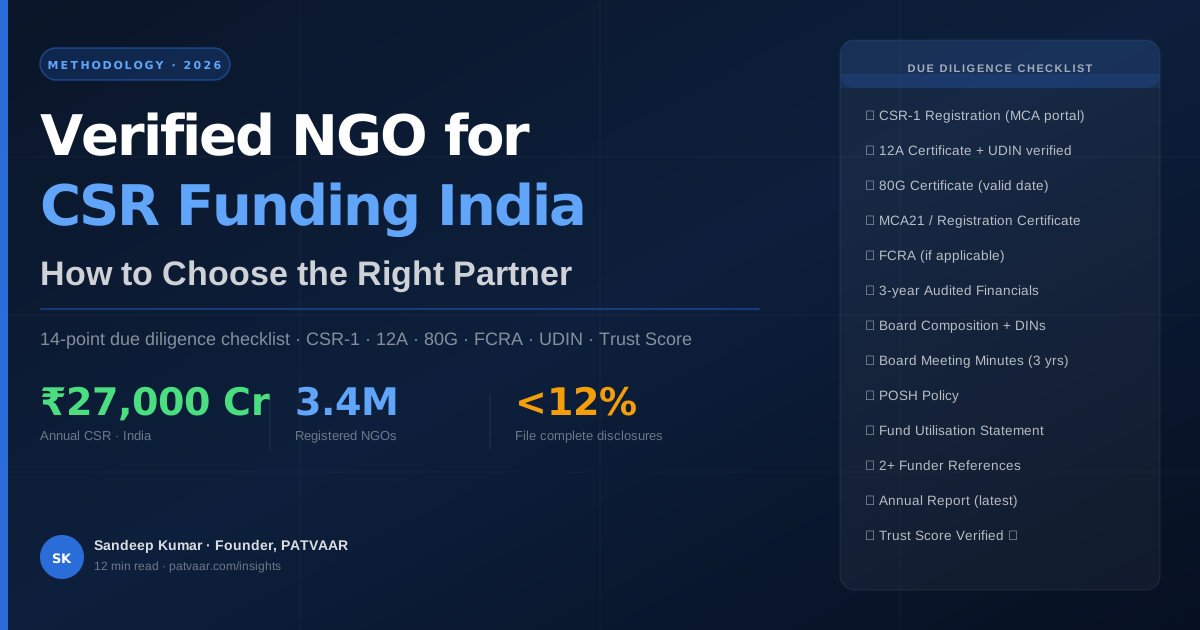
A Trust Score removes that friction before it begins. When your credibility is already independently verified and visible, the funder's due diligence is largely done before they contact you. You move from being a claim that needs checking to being a verified entity they can act on. In a funding environment where the difference between getting funded and getting passed over is often just the level of perceived risk, that shift is decisive. To understand exactly what funders examine, read our guide on the NGO due diligence checklist CSR teams use.
The Five Weighted Pillars
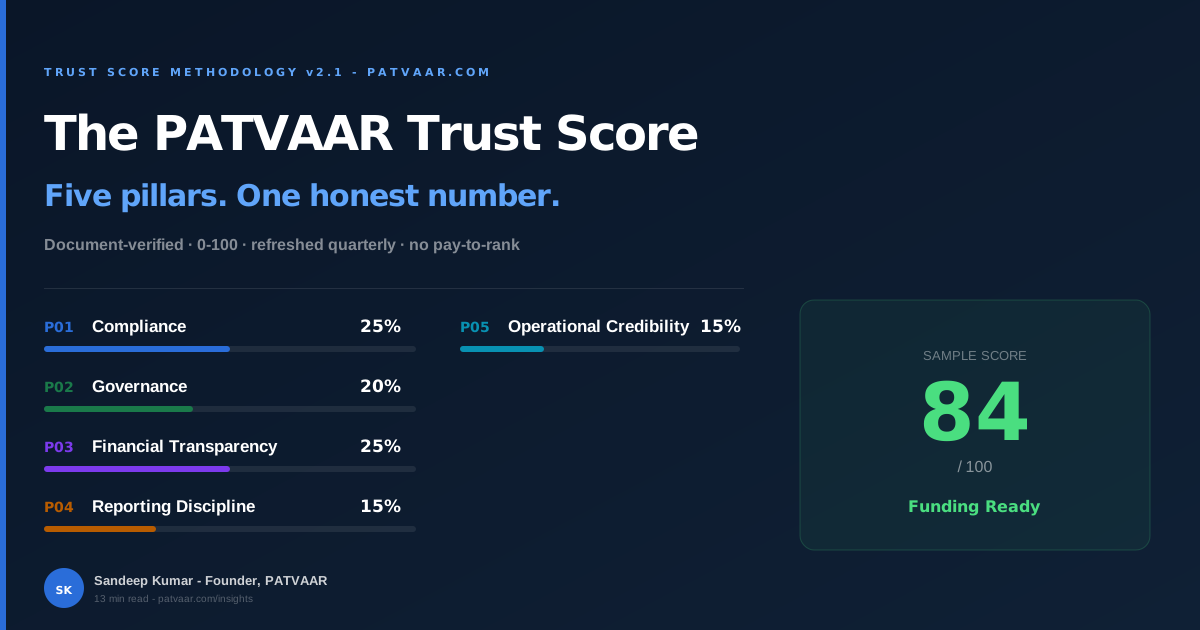
A meaningful score cannot rest on a single factor. An NGO might have perfect tax compliance but weak governance, or strong governance but opaque finances. To capture the full picture, the Trust Score is built across five distinct pillars, each carrying a defined weight and each checked against source documents.
The weights are deliberate. Compliance and Financial Transparency carry the most weight, at 25% each, because they are the areas where funders face the greatest legal and reputational risk. Governance follows at 20%. Reporting Discipline and Operational Credibility each carry 15% — important, but secondary to the legal and financial foundations. Together they sum to a single honest number out of 100.
The value of separating these five pillars is that it shows a funder not just how trustworthy an organisation is overall, but exactly where its strengths and gaps lie. An organisation strong on compliance and finances but thin on operational track record is a different proposition from one with deep field credibility but governance gaps. The pillar breakdown lets funders make that judgment — and lets you see precisely what to improve.
How the Score Is Computed and Verified
Each pillar is scored from inputs that are cross-referenced against the relevant authority. Registration and CSR-1 status are checked against the Ministry of Corporate Affairs. Tax exemptions under 12A and 80G are confirmed against the Income Tax Department. Audit reports are validated through UDIN, which confirms a chartered accountant genuinely signed off on the financials. FCRA status, where relevant, is checked against the Ministry of Home Affairs portal. These are all primary government sources — no third-party proxies.
Where a pillar falls short, the deduction is itemized rather than hidden, so you can see exactly what cost you points. Certain serious failures act as hard-fail triggers that cap the score regardless of strength elsewhere — for example, lapsed statutory registration. And every score carries a confidence band reflecting how complete and current the underlying documentation is. This is what separates a Trust Score from a self-assessment, and why it carries weight with funders that a self-published profile never could.
Understanding the Score Bands
The numerical score is precise, but humans think in categories. The score translates into bands that give an immediate sense of where an organisation stands.
A lower band is not a permanent mark against an organisation. A young NGO doing excellent work will naturally start lower simply because it has less verified track record and reporting history. The band tells a funder what kind of partnership is appropriate today, not whether the organisation is worth funding at all. Some funders specifically seek out emerging organisations to support grassroots work.
Your Score Is Not a One-Time Stamp
One of the most important things to understand is that the Trust Score is refreshed every quarter, on a 90-day cadence. It is not a certificate you earn once and display forever. As your filings, audits, and reports come in, your score updates to reflect your current verified state.
This matters in both directions. An organisation that lets a registration lapse or misses reporting cycles will see its score reflect that. An organisation that steadily strengthens its compliance, governance, and reporting will see its score climb quarter over quarter. The score rewards sustained discipline, not a one-off scramble to look good for a single application.
How to Improve Your Trust Score
Because the score is built on five clearly-defined pillars, it tells you exactly what to work on. Improving it is not a matter of better presentation — the score measures verified reality, not how well you describe yourself. Here is how to strengthen each pillar.
P01 — Compliance (25%)
This is the foundation and usually the fastest to improve. Ensure your 12A and 80G registrations are current and not approaching expiry, confirm your CSR-1 registration is active, and complete FCRA if you are eligible and seek foreign funding. Because compliance is the highest-weighted pillar alongside finance, gains here move your overall score the most. If any registration is missing, start with our CSR-1 registration guide and 12A and 80G guide.
P02 — Governance (20%)
Governance improves when your board demonstrates genuine independence and oversight. A board composed entirely of family members signals concentration of control. Add independent members with relevant expertise, maintain a regular meeting cadence with proper minutes, and put POSH compliance in place. For founders weighing how legal structure affects governance, our guide on Section 8 vs Trust vs Society is directly relevant.
P03 — Financial Transparency (25%)
The other highest-weighted pillar. It rewards three years of clean, UDIN-verified audited accounts, the absence of unexplained restatements, properly disclosed related-party transactions, and disciplined management of reserves. Funders look closely at how much of every rupee reaches the field. Timely audits and transparent financial records build this pillar over successive years.
P04 — Reporting Discipline (15%)
This pillar rewards a consistent quarterly reporting cadence, beneficiary attestation, and outcome-focused documentation. Vague reporting that describes activities without outcomes scores poorly. Reporting that states specific, attestable results — how many beneficiaries, what measurable change — scores well. Building a habit of rigorous quarterly reporting compounds over time.
P05 — Operational Credibility (15%)
This is the pillar that genuinely takes time, because it is built from field visits, partner references, and a functioning grievance redressal mechanism. There is no shortcut, but there is a right approach: document everything, maintain references from credible partners, and put a real grievance process in place. An organisation that operates transparently in the field will see this pillar strengthen naturally.
Common Misconceptions About the Trust Score
"A high score guarantees funding." It does not. The score removes the credibility barrier and gets you taken seriously, but funders still choose based on fit, sector, geography, and the strength of your specific proposal. The score gets you into the room; your proposal wins the grant.
"A low score means we are not good enough." Not true. A low score usually reflects youth or gaps in documentation, not poor work. Many lower-band organisations do exceptional work and simply have not yet built the verified track record and reporting history that lift the score.
"Once scored, always scored." No. The score is refreshed every quarter and reflects your current verified state, not a permanent label.
"We can improve our score by writing better." No. The score measures verified reality, not presentation. The only way to improve it is to strengthen the underlying compliance, governance, finances, reporting, and operations it measures.
"You can pay for a better score." No. The methodology is public, scoring is document-driven, and there is no premium tier that buys a higher number or better visibility. That is the point of a credibility score.
Why Verified Credibility Is Becoming Non-Negotiable
The direction of travel in Indian philanthropy and CSR is unmistakable. Funders are under increasing pressure — from boards, from regulators, from their own ESG commitments — to demonstrate that their funds reach credible, well-governed organisations. Manual due diligence at Rs 40 lakh a grant does not scale to meet that pressure. Independent, document-verified scoring does.
This means that over the coming years, verified credibility will shift from a competitive advantage to a baseline expectation. The organisations that establish a strong Trust Score early will be the ones funders turn to first. Those that wait will keep explaining, again and again, credibility that others have already proven. Building your verified credibility now is an investment in being findable and fundable as the entire sector moves in this direction.
How to Get Your Trust Score
The process is straightforward. You register, upload your statutory documents, audits, and governance disclosures through your dashboard, and PATVAAR runs live checks against MCA, the Income Tax department, the MCA21 CSR registry, and the FCRA portal. Within seven working days, your Trust Score is computed across the five pillars and published to your profile with its band, confidence band, and itemized breakdown — where CSR teams browsing the registry can find you.
Verification is free during the current Beta period. There are no agent fees and no charges to be listed. Once your score is published, you become discoverable to funders searching by tier, compliance status, geography, and cause — which means some funding conversations may begin with a funder reaching out to you. To see how this fits the wider funding journey, read our guide on how to get CSR funding for your NGO.
Find out where your NGO stands.
Get your verified Trust Score across five pillars. Free during Beta. Published in 7 days.
Frequently Asked Questions
What is the PATVAAR Trust Score?
It is India's first standardised, document-verified credibility score for NGOs — a single number from 0 to 100 computed from verified documents across five weighted pillars: Compliance, Governance, Financial Transparency, Reporting Discipline, and Operational Credibility. It is not a survey and not self-reported.
How is the Trust Score calculated?
Each of the five pillars is scored from documents cross-referenced against primary government sources — MCA21 for registration and CSR-1, the Income Tax portal for 12A and 80G, UDIN for audit verification, and the MHA portal for FCRA. The pillars are weighted (Compliance 25%, Governance 20%, Financial Transparency 25%, Reporting 15%, Operational Credibility 15%) and combine into a single score out of 100.
What do the Trust Score bands mean?
90–100 is Institutional Grade (ready for large grants), 80–89 is Funding Ready (eligible for most CSR mandates), 70–79 is Emerging Organisation (good standing, improving), 60–69 is Needs Improvement (compliance gaps), and below 60 is High Risk (significant issues to resolve).
Does a high Trust Score guarantee CSR funding?
No. The score removes the credibility barrier and gets your organisation taken seriously, but funders still choose based on fit, sector, geography, and the strength of your specific proposal. The score gets you into the room; your proposal wins the grant.
How can an NGO improve its Trust Score?
By strengthening the five pillars: keep all registrations current (Compliance), build genuine board independence and POSH compliance (Governance), maintain clean UDIN-verified audits (Financial Transparency), report quarterly with beneficiary attestation (Reporting), and maintain field visits, partner references and grievance redressal (Operational Credibility). Presentation does not improve the score — only verified reality does.
How often is the Trust Score updated?
Every quarter, on a 90-day cadence. The score is not a one-time stamp; it reflects your current verified state as filings, audits, and reports come in.
Can you pay for a higher Trust Score?
No. The methodology is public, the weights and deductions are itemized, and there is no premium tier that buys a higher score or better visibility. A credibility score that could be bought would be worthless.
How long does it take to get a Trust Score?
Your Trust Score is computed and published within seven working days of submitting all required verification documents. Verification is free during the current Beta period.