Impact measurement is the part of NGO work that most organisations do last and least well. The programme runs, the money is spent, the beneficiaries are served — and then, when a funder asks what changed, the answer is vague. "We reached 2,000 families." "We conducted 48 workshops." "Awareness improved." None of that is impact. This guide explains what impact measurement actually means, why CSR teams now demand it at a level that most NGOs are unprepared for, and exactly how to build the systems that make strong reporting possible.
The stakes are higher than they used to be. A decade ago, a well-intentioned NGO with a compelling story and clean accounts could secure CSR funding on goodwill alone. That era is ending. Companies now have board-level CSR committees, annual report obligations under the Companies Act, and ESG frameworks that require demonstrated outcomes. The question is no longer "did you spend the money?" It is "what changed because of it, and how do you know?"
The Difference Between Outputs, Outcomes, and Impact
Before anything else, you need to be precise about what you are measuring. The three terms are used interchangeably in most NGO reports, and that imprecision is one of the primary reasons funders lose confidence in the reporting they receive.
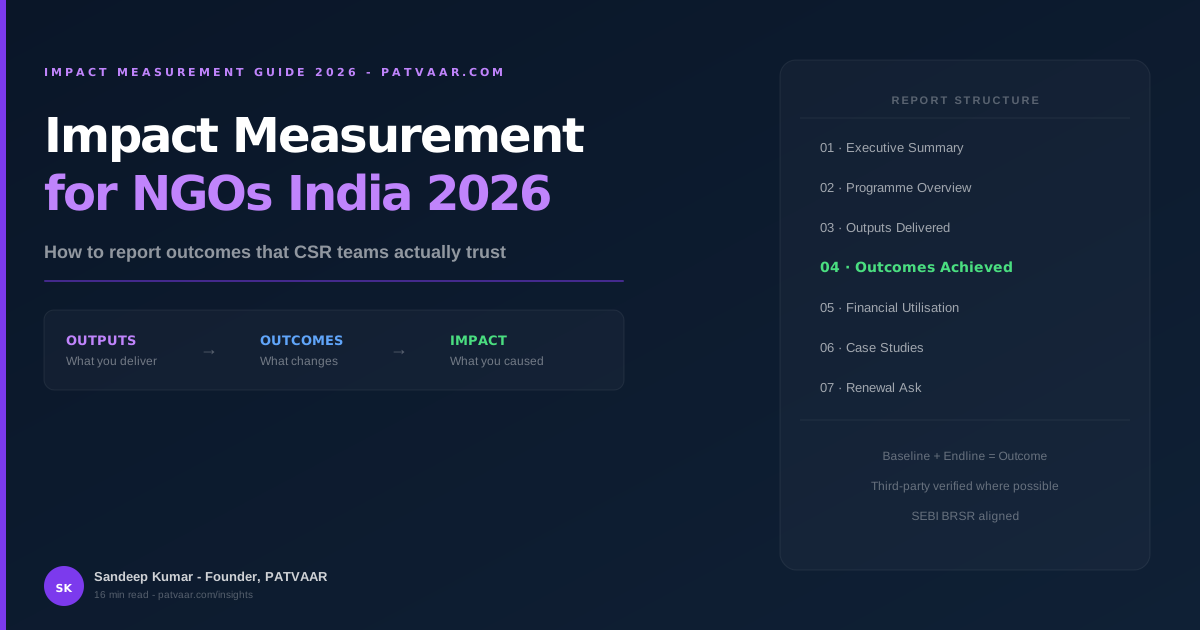
Outputs are what you produce or deliver. The number of training sessions conducted, the number of children enrolled, the number of health camps organised, the number of books distributed. Outputs are easy to count and important to track, but they tell a funder nothing about whether anything changed as a result of your work.
Outcomes are the changes that result from your outputs. Knowledge gained. Skills acquired. Behaviour changed. Income increased. Health status improved. Outcomes require measurement at two points — before the intervention (baseline) and after (endline) — so that the change can be quantified. Without a baseline, you cannot demonstrate an outcome; you can only assert one.
Impact is the portion of the outcome that is attributable to your work specifically, after accounting for what would have happened anyway. If literacy rates in your target district would have improved by 8% without any intervention, and you achieved 14% improvement, your attributable impact is 6 percentage points. Impact is the hardest to measure and the most honest metric.
Most NGO reports are full of outputs and empty of outcomes. Most CSR teams have learned to read past the output numbers and look for outcome evidence. If you cannot provide outcome data, the report lands in the pile that does not lead to renewals. If you can provide it, you stand apart from almost every other NGO they fund.
Why CSR Teams Demand Better Impact Data Now
The shift is structural, not optional. Under the Companies Act 2013, companies must report CSR spending to their board and in their annual report. The board wants to know what the money achieved. The annual report is public. Shareholders, institutional investors, and increasingly the media read it. A company that spent Rs 5 crore on education and can only report "trained 3,000 people" is exposed to legitimate criticism that its CSR is opaque.
The SEBI Business Responsibility and Sustainability Report (BRSR) framework, now mandatory for the top 1,000 listed companies, requires companies to disclose social impact metrics with increasing specificity. Companies that want to make credible disclosures need their NGO partners to provide data that survives scrutiny. That pressure flows directly to you.
The practical result is that sophisticated CSR teams now ask, before funding, not just "what will you do?" but "how will you measure it, who will verify it, and what format will the data come in?" NGOs that cannot answer these questions clearly are no longer competitive for serious grants, regardless of the quality of their field work. Read our guide on writing a CSR proposal that gets funded for how to address these questions at the proposal stage.
Building a Measurement Framework Before the Programme Starts
The most common measurement mistake is deciding what to measure after the programme has run. By then, baseline data does not exist, the opportunity to track change over time has passed, and you are left constructing retrospective narratives instead of reporting evidence.
Measurement design must happen at programme design. Before you spend the first rupee, you need to answer five questions.
1. What specific change are we trying to produce?
Be concrete and narrow. "Improving livelihoods" is not an answer. "Increasing monthly household income of women participating in our tailoring programme from a baseline of Rs 4,200 to Rs 7,500 within 12 months" is an answer. The specificity is uncomfortable at first, because it commits you to a measurable target. That discomfort is appropriate — you are holding yourself to account.
2. What is the baseline?
Baseline data captures the situation before your intervention. It must be collected at or before the start of the programme, from the same population you will measure at endline. A baseline survey conducted two months into a programme has been contaminated by the programme itself. Do it before, or as close to the start as possible. If you are working with an existing dataset (government surveys, district-level statistics), document your source and methodology carefully.
3. What indicators will we track?
Indicators are the specific, measurable variables that tell you whether the outcome is happening. For an education programme, indicators might include: reading fluency measured by oral reading assessment, attendance rate, school retention at the end of the academic year. Choose indicators that are specific, measurable, attributable to your programme, realistic to collect, and time-bound — the classic SMART framework applied to metrics rather than goals.
4. How will we collect the data?
Data collection methodology matters as much as the data itself. A CSR team reviewing your report will ask: who collected this data, using what tool, with what sampling approach, and could the data have been manipulated? The answers need to hold up. Options range from simple pre-post surveys administered by your own team (lower cost, lower credibility) to third-party assessments commissioned from an independent organisation (higher cost, significantly higher credibility with funders).
5. Who will verify it?
Unverified self-reported data is the weakest form of impact evidence. Verification can come from several sources: beneficiary attestation (signed statements from beneficiaries or their households), third-party assessment, government data cross-referencing, or independent evaluation. The verification method you choose should be proportionate to the grant size and the funder's requirements. A Rs 10 lakh grant may not require a full third-party evaluation. A Rs 2 crore grant almost certainly does.
The Theory of Change — Your Programme's Logic Map
A Theory of Change is a document that maps the logical pathway from your activities to your intended impact, making explicit every assumption along the way. It is not a bureaucratic requirement imposed by international funders. It is the single most useful thinking tool for designing programmes that actually work — and for explaining them to funders in a way that builds confidence.
A simple Theory of Change reads: "If we do X activities with Y population, then Z outputs will result. If those outputs reach the right people in the right way, then A outcomes will follow. Those outcomes will contribute to B long-term impact, assuming C contextual conditions hold."
The assumptions matter. An education programme that assumes children will attend regularly, that teachers will be present and trained, and that parents will value education must validate those assumptions. If attendance is 60%, the theory breaks down. A Theory of Change that acknowledges these dependencies gives a funder confidence that you understand your own programme's risks — which is far more reassuring than a programme description that presents only the optimistic scenario.
Practical tip: Your Theory of Change does not need to be a dense academic document. A single A4 page with a clear flow diagram — Activities → Outputs → Outcomes → Impact, with assumptions noted at each arrow — is sufficient for most CSR grant relationships and dramatically more useful than nothing.
What to Include in a CSR Impact Report
An impact report for a CSR funder is not the same as your annual report for public disclosure, nor the same as a government utilisation certificate. It is a specific document written for a specific audience — a CSR manager who needs data to present to their board, fit their annual report narrative, and justify the renewal of your grant.
Write it with that reader in mind. Here is the structure that works.
Executive Summary — Half a page
The grant amount, the period, the headline outcome achieved, and the cost per beneficiary. A CSR manager should be able to lift this paragraph directly into their board presentation. If it takes more than 30 seconds to extract your key numbers, rewrite it.
Programme Overview — One page
What you set out to do, the geography, the target population, and the timeline. This should match your original proposal. If the programme changed significantly from the proposal — geography shifted, beneficiary numbers changed, activities were modified — explain why and what you did about it.
Outputs Delivered — Half a page
The concrete deliverables: sessions conducted, beneficiaries reached, materials distributed, infrastructure completed. Present these as a simple table with planned versus actual, and explain any gaps. Funders know that targets are not always met; honest explanation builds more trust than inflated numbers.
Outcomes Achieved — One to two pages
This is the heart of the report. Present your baseline, your endline, and the change between them for each outcome indicator. Use the same indicators you agreed with the funder at the proposal stage, or explain clearly why indicators changed. Show the data collection methodology. Where you have third-party verification, lead with it.
Financial Utilisation — One page
Expenditure against budget, line by line. Administrative cost as a percentage of total grant. Unspent funds and what will happen to them. For CSR grants, a clean financial utilisation statement signed by your CA with UDIN is the standard expectation. Anything less will slow down your renewal. Read our guide on what CSR teams examine in NGO due diligence for the full financial documentation picture.
Case Studies — One to two pages
Two or three individual stories that put a human face on the outcome data. Not fabricated or composite stories, but real people with their genuine experience of your programme. Include their name and a photograph where consent has been obtained. These carry the emotional resonance that numbers cannot, and CSR managers use them in their own internal communications.
Next Steps and Renewal Ask — Half a page
If you are seeking renewal, say so explicitly and include a brief outline of what the next phase will achieve. Do not make funders infer that you want to continue — state it clearly with a proposed grant amount.
Common Impact Reporting Mistakes
Reporting reach as impact. "We reached 5,000 people" is not an impact statement. Reaching people is an output. What changed for those 5,000 people is the outcome. What changed because of your specific intervention, above and beyond what would have happened anyway, is the impact.
Changing indicators without explanation. If your proposal committed to measuring reading fluency and your report measures attendance instead, a CSR team will notice. Explain any indicator changes, with the reason and a comparison between what was planned and what was measured.
Self-reported data without verification. Data collected by your own team about your own programme has an inherent credibility problem. It is not that funders assume you are lying — it is that they cannot confidently show it to their board without independent verification. For grants above Rs 25 lakh, budget for third-party assessment from the start.
Late reporting. Most CSR funders require quarterly or semi-annual progress reports, with a final report within 60–90 days of grant closure. Late reports signal poor organisational discipline and make the renewal conversation harder before it begins. Build reporting deadlines into your programme calendar on day one.
Glossing over failure. Programmes rarely achieve everything they planned. Funders know this. An honest account of what worked, what did not, and what you learned builds significantly more trust than a uniformly positive report that strains credibility. Sophisticated CSR managers are experienced enough to know when they are being told only what they want to hear.
Tools and Frameworks for Impact Measurement
You do not need expensive software or a dedicated monitoring and evaluation team to do impact measurement well. What you need is discipline and the right tools applied consistently.
KoboToolbox is a free, open-source data collection platform widely used in the development sector. It allows you to design surveys, collect data on mobile devices in the field without internet connectivity, and analyse results. For NGOs without dedicated M&E software, it is the starting point.
ODK (Open Data Kit) is another free mobile data collection tool with similar capabilities. Both KoboToolbox and ODK integrate with Google Sheets and other analysis tools, making data management accessible without specialist skills.
Social Return on Investment (SROI) is a methodology for quantifying social value in financial terms. It assigns a monetary proxy value to outcomes — for example, the economic value of improved literacy in terms of future earnings — and expresses your impact as a ratio (for every Rs 1 invested, Rs X of social value was created). SROI is demanding to compute rigorously, but a simplified version can be compelling in CSR reports. The UK Cabinet Office's SROI guide is the standard reference and is freely available online.
The Logical Framework (Logframe) is a project management and reporting tool that maps activities, outputs, outcomes, and impact in a matrix format alongside indicators, verification means, and assumptions. It is standard in international development funding and increasingly familiar to sophisticated CSR teams in India.
Aligning Your Measurement to the CSR Company's Reporting Needs
Every company you partner with has its own CSR reporting framework, annual report narrative, and Board CSR Committee requirements. The most effective NGO-funder relationships are those where the NGO proactively understands what the company needs to report and designs its measurement accordingly.
Ask your CSR contact two questions before designing your measurement framework: "What does your board need to see in the annual report?" and "What does your company's CSR policy define as success?" The answers will tell you which indicators matter most to them, what level of verification they require, and what format they prefer to receive data in. Building your measurement to answer those questions specifically — while maintaining your own programme integrity — is the difference between a transactional grant relationship and a long-term partnership.
Companies that are aligned with the UN Sustainable Development Goals in their ESG reporting will particularly value NGO partners that can map their outcomes to specific SDG targets and indicators. If your work contributes to SDG 4 (Quality Education), reporting your outcomes using the SDG 4 indicator framework — which most development-oriented funders already understand — positions your report in a language your funder can directly use.
How PATVAAR Verification Strengthens Your Impact Reports
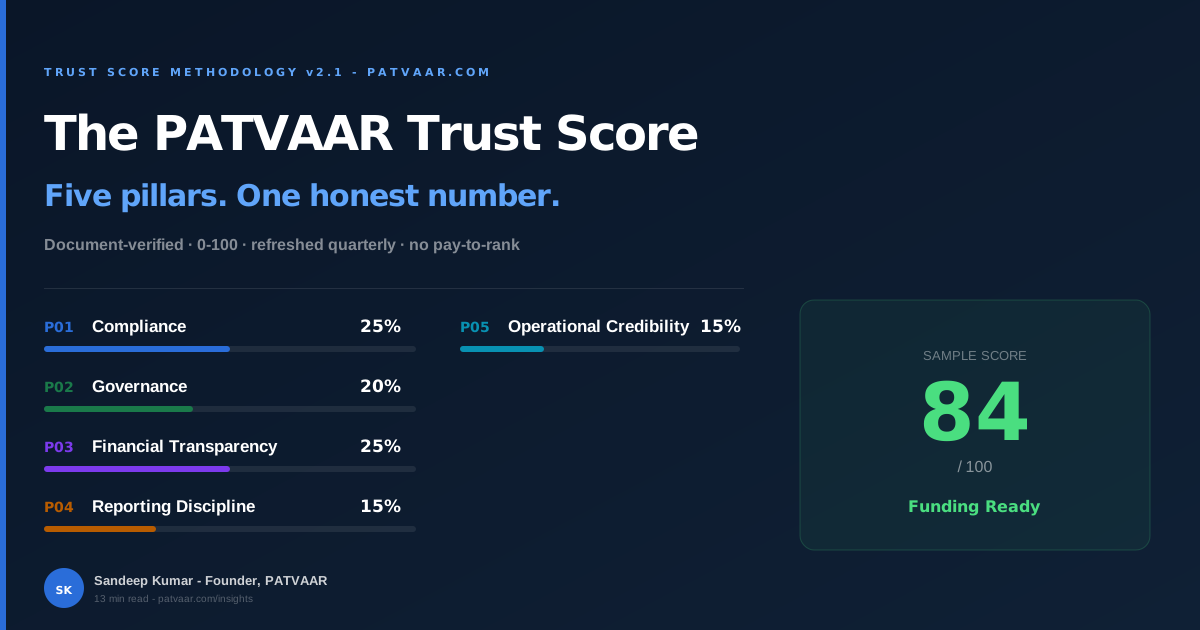
A verified PATVAAR Trust Score strengthens your impact reports in two specific ways. First, the Reporting Discipline pillar of the Trust Score (P04, weighted at 15%) rewards NGOs that demonstrate a consistent quarterly reporting cadence and beneficiary attestation — which means your reporting discipline is independently certified, not self-declared. Second, CSR teams browsing the PATVAAR registry can see your verified profile before they engage, which means the credibility conversation is already largely resolved by the time your impact report arrives. The report then only needs to demonstrate outcomes, not re-establish the organisation's trustworthiness.
If you are not yet verified on PATVAAR, the Trust Score guide explains what the verification process covers and how to strengthen each pillar. Apply for free verification here — Trust Score is published within seven working days.
Make your impact reports carry verified credibility.
Get your PATVAAR Trust Score. Free during Beta. Published in 7 days.
Frequently Asked Questions
What is the difference between outputs, outcomes, and impact for NGOs?
Outputs are what you deliver — sessions conducted, people trained, materials distributed. Outcomes are the changes that result — knowledge gained, income increased, health improved. Impact is the portion of the outcome attributable specifically to your intervention, above what would have happened without you. Most NGO reports measure outputs well and outcomes poorly. CSR teams now require outcome evidence.
Why do CSR teams require impact measurement from NGOs?
Companies must report CSR spending outcomes to their board and in their annual report under the Companies Act. SEBI's BRSR framework for the top 1,000 listed companies requires social impact disclosures with increasing specificity. Companies that want to make credible disclosures need NGO partners who can provide verifiable outcome data, not just activity counts.
What is a baseline survey and why is it important?
A baseline survey measures the situation before your intervention begins — the starting point against which you will measure change. Without baseline data, you cannot demonstrate that a change occurred or that your programme caused it. It must be conducted at or before the start of the programme, from the same population you will measure at endline.
Do NGOs need a Theory of Change?
Not formally, but practically yes. A Theory of Change maps the logical pathway from your activities to your intended impact and makes your assumptions explicit. It is the most useful tool for programme design, for explaining your work to funders convincingly, and for identifying where your programme might fail. A simple one-page flow diagram is sufficient for most CSR grant relationships.
What should a CSR impact report include?
An executive summary with headline outcome data, a programme overview matching the original proposal, a planned versus actual output table, the core outcomes section with baseline and endline data, a financial utilisation statement, two or three beneficiary case studies, and a next steps or renewal ask if applicable.
How often should NGOs submit impact reports to CSR funders?
Most CSR funders expect quarterly or semi-annual progress reports, with a final impact report within 60 to 90 days of grant closure. Check your grant agreement for specific timelines. Late reporting signals poor organisational discipline and makes renewal conversations harder.
What tools do NGOs use for impact data collection?
KoboToolbox and ODK are the most widely used free mobile data collection tools in the sector. Both allow offline data collection in the field and integrate with spreadsheet tools for analysis. For financial tracking, any accounting software with CA-auditable output is appropriate. For programme reporting, the Logical Framework (Logframe) is the most widely understood structure among development funders.
Should NGOs use third-party evaluation for impact assessment?
For grants above Rs 25 lakh, third-party evaluation is strongly recommended and increasingly expected by sophisticated CSR teams. Self-reported data has an inherent credibility limitation — not because funders assume dishonesty, but because it cannot be independently verified when the company presents it to its board. Budget for third-party assessment at the proposal stage, not as an afterthought.