Most NGO annual reports are read by almost nobody. They are produced because donors expect them, filed because compliance requires them, and then quietly forgotten. The rare annual report that actually gets read — the one that a CSR manager shares with their team, that a new funder bookmarks, that a government official cites — is built differently. It is not a compliance document dressed up as a publication. It is a credibility instrument that happens to also meet regulatory requirements. This guide explains how to build one that does both jobs well.
The NGO annual report is also one of the four or five documents that determine whether a CSR team funds you. When a company's due diligence team requests your last three annual reports and finds thin, template-looking documents with vague impact claims and no financial detail, the conversation about a grant is effectively over. When they find reports that are honest, specific, data-driven, and clearly written, the conversation accelerates. The annual report you produce this year is the document that will either open or close funding conversations two years from now.
Who Actually Reads an NGO Annual Report
Before writing a single word, you need to know who you are writing for. An NGO annual report has at least four distinct audiences, and the best reports serve all of them without being bloated by trying to be everything at once.
CSR teams and corporate funders are your most important reader. They read annual reports during due diligence before making a funding decision. They look for financial discipline, measurable outcomes, governance clarity, and evidence that past grants were delivered well. They read quickly, they skip the inspirational language, and they go straight to the numbers and the case studies.
Individual and institutional donors want to know that their money was used well and that the organisation is worth continuing to support. They read the impact stories and the financial summary. They are less interested in governance structure and more interested in stories of change.
Government bodies and regulators including the Income Tax Department, Charity Commissioner offices, and the Ministry of Home Affairs for FCRA purposes look at the annual report as supporting evidence of your organisation's activities and financial conduct. Clarity, accuracy, and consistency with your statutory filings matter most to them.
Your own board and staff use the annual report as an organisational mirror — a document that forces you to articulate what you actually achieved, where you fell short, and what you learned. The discipline of writing an honest annual report is one of the most valuable things a leadership team can do for its own clarity of thinking.
The Regulatory Context — What Is Actually Required
Before dealing with what makes an annual report excellent, it is worth being clear about what is legally required, because many NGOs conflate compliance minimum with best practice.
For Section 8 Companies, the Companies Act 2013 requires an annual report to the members that includes the financial statements, the Board's report, and the auditor's report. The Board's report must include details of CSR activities undertaken, changes in the nature of business, risk management policies, and related party transactions. This is filed with the Registrar of Companies through MCA21 and is publicly accessible.
For Trusts and Societies, the requirements vary by state and governing legislation. Charitable Commissioner offices in Maharashtra and Gujarat require annual accounts and an activity report. Most states require some form of annual filing with the Registrar of Societies. These requirements are the floor, not the ceiling.
For any organisation holding FCRA registration, an annual return must be filed with the Ministry of Home Affairs by December 31 each year, disclosing all foreign contributions received and their utilisation. This is separate from the annual report and is publicly accessible on the FCRA portal — which means any funder can check it. Read our complete FCRA registration guide for the full compliance picture.
For organisations with 12A and 80G registration, ITR-7 must be filed annually by October 31. The Form 10B audit report, mandatory for organisations with income exceeding Rs 5 lakh, is submitted alongside the ITR-7. These filings form part of the compliance record that PATVAAR cross-references during Trust Score verification.
The Structure of an Effective NGO Annual Report
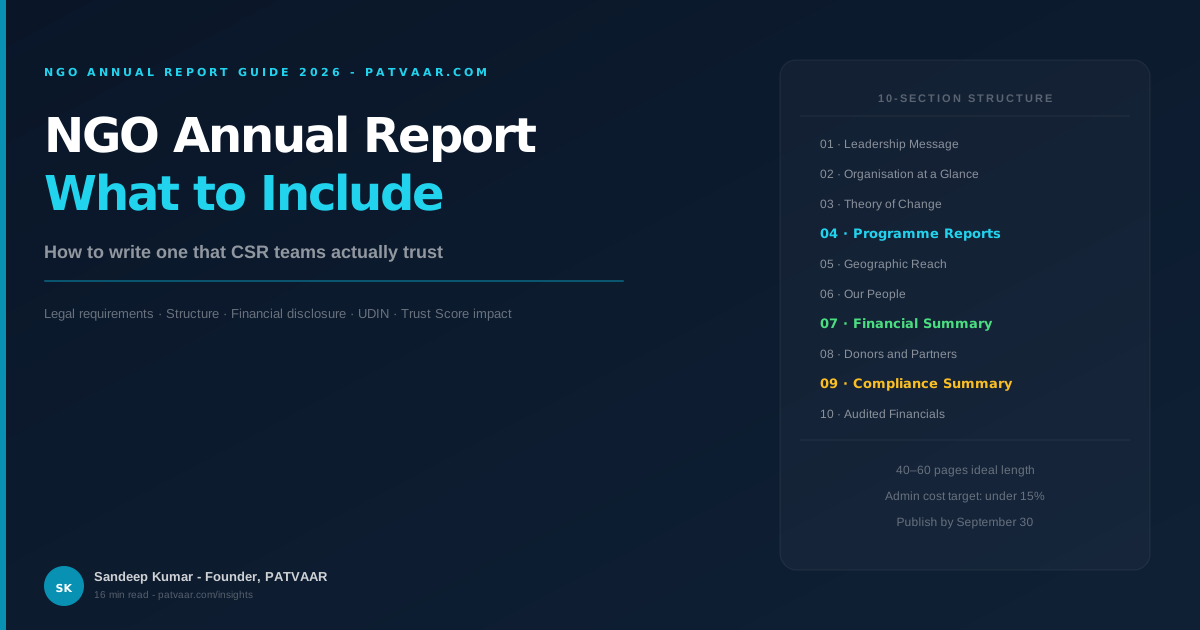
An annual report that serves both compliance and credibility needs a structure that flows logically from vision to evidence. Here is the sequence that works, with the purpose of each section explained.
1. Opening Message from Leadership — Two Pages Maximum
This is the one place in the report where a personal voice is appropriate. The founder or executive director speaks directly to the reader about the year — what it demanded, what was achieved, what was difficult, and where the organisation is headed. The most effective opening messages are honest about difficulty, specific about achievement, and forward-looking without being vague. Generic language about "continuing our mission" and "thanks to all our supporters" is a wasted opportunity. A leader who can say "this year we failed to reach our target in Rajasthan and here is what we learned" will be taken far more seriously than one who presents only successes.
2. Organisation at a Glance — One Page
A snapshot that gives a first-time reader orientation in 60 seconds. Include: year of founding, legal structure, registration numbers (Section 8/Trust/Society, 12A, 80G, CSR-1, FCRA where applicable), primary cause areas, geographic presence, total beneficiaries reached in the year, total funds received and utilised. Keep it factual and tight. This page is what a CSR manager's assistant reads before deciding whether to pass the report up the chain.
3. Our Theory of Change — One Page
A clear, visual representation of how your work creates change. Activities lead to outputs, outputs lead to outcomes, outcomes contribute to impact. The assumptions that must hold for each link in the chain should be explicitly stated. This section tells a sophisticated funder that you understand why your programme works, not just what it does. It is also the section most NGOs skip — which is precisely why including it differentiates you. Read our guide on impact measurement for NGOs for a full explanation of how to build a Theory of Change.
4. Programme Reports — Two to Four Pages Per Programme
This is the substantive heart of the report. Each programme gets its own section with the same consistent structure: what we set out to do, who we served (demographic profile of beneficiaries), what we delivered (outputs), what changed (outcomes with baseline and endline data), what it cost (budget utilisation for this programme), and what we learned. The consistency of structure across programmes signals organisational discipline to funders reviewing the report.
The outcomes section is where most NGO reports fall short. "Awareness improved" and "participants gained skills" are not outcomes. "Reading fluency among participating children improved from a baseline of 28% to 54% over 18 months, measured by independent oral reading assessment of a stratified sample of 240 children" is an outcome. The specificity is what gives a funder something concrete to put in front of their board.
5. Geographic Reach — One Page
A map and brief summary of where you work, with the number of districts, villages, or urban wards and the beneficiary count by geography. For organisations working across multiple states, this section helps a funder understand the geographic profile of your work and assess its fit with their own CSR focus areas.
6. Our People — One to Two Pages
The board or trustee composition, including brief professional bios and the nature of each member's independence or expertise. The senior leadership team. A headcount of staff and volunteers. This section answers the governance questions a funder's due diligence team will ask anyway — make it easy for them to find the answers without having to contact you. If your board includes domain experts, independent members, and people with relevant sector experience, the composition speaks for itself. If it is mostly family members or founding-team associates, this is the section that will prompt questions.
7. Financial Summary — Two Pages
The financial summary is where credibility is either established or destroyed. A full set of audited financial statements belongs as an annexure. The financial summary in the body of the report translates those statements into something readable by a non-accountant funder, without losing the rigour.
Include: total income by source (grants, donations, interest, other), total expenditure by programme and administration, administrative cost as a percentage of total expenditure, closing reserves, and a brief note on unspent grants and their status. The administrative cost percentage deserves particular attention — keep it under 20% and ideally under 15%. If it is above 20%, explain why and what you are doing about it. Funders notice this number and draw inferences from it.
The audit must be UDIN-verified. Since 2019, the Institute of Chartered Accountants of India requires all audit reports to carry a Unique Document Identification Number that can be verified at udin.icai.org. An unverified audit raises an immediate red flag with PATVAAR's verification process and with sophisticated CSR teams. Read our guide on how the Trust Score's financial transparency pillar is assessed for detail on what verifiers look for.
8. Donor and Partner Acknowledgement — One Page
A list of funding partners with the grant amounts, if they have given permission to disclose. A list of implementation partners, community organisations, and government collaborators. Acknowledgements serve two functions: they honour the relationships that make the work possible, and they signal to prospective funders the quality of your existing partnerships. A funder who sees that a credible foundation or government programme already backs you is more likely to fund you themselves.
9. Compliance and Verification Summary — Half a Page
This section is rarely seen in NGO annual reports and is almost universally appreciated by CSR due diligence teams. List your current registrations with their validity dates: Section 8/Trust/Society registration number, 12A certificate number and validity, 80G certificate number and validity, CSR-1 registration number, FCRA registration and validity if applicable, PAN, and UDIN-verified audit number. Include the PATVAAR Trust Score and tier if you have one. This removes the most time-consuming part of a funder's due diligence in a single half page.
10. Audited Financial Statements — Annexure
The full set: Balance Sheet, Income and Expenditure Account, Receipts and Payments Account, Schedules, and the Auditor's Report. These go as an annexure, not in the body of the report. They must be signed by the CA with UDIN and by the authorised signatory of the organisation.
Tone, Language, and Length
The single most common mistake in NGO annual reports is the tone — either breathlessly inspirational (every sentence ends with an exclamation point and the word "transformative") or bureaucratically dry (every paragraph sounds like it was written for the Registrar of Societies). Neither builds credibility with a CSR funder.
The right tone is confident, specific, and honest. It is the tone of a competent professional organisation that knows what it is doing, has evidence for what it claims, and is not afraid to say when things were hard. Specificity is the single most reliable way to achieve this tone — replace every vague claim with a concrete number or example and the report immediately sounds more credible.
On length: most NGO annual reports are either too thin to be credible or too long to be read. The right length is 40 to 60 pages for a medium-sized organisation running three to five programmes. Larger organisations can go up to 80 pages if the programme content genuinely warrants it. Below 25 pages, a funder will wonder what you are not showing them. Above 80 pages, nobody will read it completely.
The credibility test: Before publishing your annual report, give it to someone who knows nothing about your organisation and ask them to read it for 15 minutes. Then ask: what does this organisation do, who does it serve, what changed because of its work last year, and is it financially sound? If they cannot answer all four questions from what they read, the report needs more work.
Common Mistakes That Undermine Annual Report Credibility
Vague impact language. "Lives transformed," "communities empowered," "sustainable change" — these phrases appear in virtually every NGO annual report and mean nothing to a funder who has read thousands of them. Replace every vague phrase with a specific, measurable claim.
Stock photographs. Images of smiling children from a stock photo library tell a funder nothing about your actual work. Real photographs from your own programmes — of real beneficiaries with their consent, of your field teams, of the communities you serve — are worth ten times more in building credibility.
Financials that do not match your filings. A CSR due diligence team will cross-reference your annual report financials against your ITR-7, your MCA filings if you are a Section 8 Company, and your FCRA annual return if applicable. Any discrepancy — even an innocent formatting difference — generates questions and delays. Ensure your annual report financials are drawn directly from your filed documents.
Missing compliance information. If your annual report does not include your CSR-1 registration number, 12A validity, 80G status, and UDIN-verified audit, a funder's due diligence team will have to request them separately. Every request for additional information adds friction and delays to the funding decision. Include everything proactively.
Publishing late. An annual report for the financial year ending March 31 should be published by September 30 at the latest. Publishing 18 months after the year-end is not uncommon among smaller NGOs and creates an immediate credibility problem — it signals that the organisation does not have robust internal systems. If your report is late, publish what you have and catch up, rather than waiting for perfection.
How to Use Your Annual Report After Publishing
An annual report that sits on your website and nowhere else is a wasted asset. Here is how the strongest NGOs use theirs.
Send it directly to every existing funder and donor, personally, with a short cover note that highlights two or three specific achievements relevant to their grant. Do not send a broadcast email — send individual messages that reference the specific programme they funded.
Send it to every prospective funder you are approaching for new grants. Include it with every proposal as background reading. Upload it to your PATVAAR profile so that CSR teams browsing the registry have immediate access to it.
Share excerpts on LinkedIn — specific impact data, compelling case studies, governance highlights — with links back to the full report. Annual report content makes excellent long-form LinkedIn posts for an organisation's page and its leadership team's personal profiles.
Submit it with your ITR-7, your Charity Commissioner annual return, and your FCRA annual return where required. Regulators who receive a well-organised annual report alongside the statutory filings form a positive impression of the organisation's discipline.
Annual Report and the PATVAAR Trust Score
Your annual report directly affects two pillars of your PATVAAR Trust Score. The Reporting Discipline pillar (P04, 15% weight) rewards organisations that publish consistent, outcome-focused reports with beneficiary attestation. The Financial Transparency pillar (P03, 25% weight) is verified against your UDIN-verified audited financial statements — which form the core financial section of your annual report.
An organisation that publishes a strong, well-documented annual report annually will see both pillars strengthened at each quarterly review. An organisation that publishes late, thin, or vague reports will see those pillars drag on its composite score. The annual report is not just a communication tool — it is a scoring input that affects your discoverability and fundability on the platform. Read our complete Trust Score guide for detail on how each pillar is assessed.
If you are not yet verified on PATVAAR, your annual report is one of the primary documents the verification process reviews. Having three years of clean, UDIN-verified, consistently published annual reports significantly accelerates the verification process and strengthens your composite score from the outset. Apply for free verification here.
Let your annual report work harder for you.
Get verified on PATVAAR. Trust Score published in 7 days. Free during Beta.
Frequently Asked Questions
Is an annual report legally required for NGOs in India?
Yes, in various forms depending on legal structure. Section 8 Companies must file an annual report including audited financials, Board's report, and auditor's report with the Registrar of Companies. Trusts and Societies must file activity and financial reports with state-level authorities. FCRA-registered organisations must file FC-4 annually. 12A-registered organisations must file ITR-7 by October 31 each year.
How long should an NGO annual report be?
Between 40 and 60 pages for a medium-sized organisation running three to five programmes. Below 25 pages, a funder may question whether you are disclosing enough. Above 80 pages, the report is unlikely to be read fully. Length should be driven by the substance of your programmes and financial detail, not by a desire to appear comprehensive.
What financial information must an NGO annual report include?
At minimum: income by source, expenditure by programme and administration, administrative cost as a percentage of total expenditure, closing reserves, and a UDIN-verified audited financial statement as an annexure. The administrative cost ratio is a number CSR teams look at directly — keep it under 15% where possible.
What is UDIN and why does it matter for an NGO annual report?
UDIN is the Unique Document Identification Number issued by the Institute of Chartered Accountants of India for every audit certificate or report. Since 2019, all audit reports must carry a UDIN to be considered valid. A UDIN-verified audit can be independently confirmed at udin.icai.org. An audit without UDIN is flagged during PATVAAR verification and raises concern with CSR due diligence teams.
When should an NGO publish its annual report?
For the financial year ending March 31, the annual report should be published by September 30 at the latest — ideally by July 31. Publishing after December signals poor internal systems and creates problems for funders who need current documentation for their own annual reporting cycles.
What is the difference between an NGO annual report and statutory filings?
An annual report is a communication document — written for donors, funders, and stakeholders to understand what the organisation achieved and how it operates. Statutory filings (ITR-7, MCA annual return, FCRA FC-4, Charity Commissioner returns) are regulatory compliance documents. The annual report draws from the statutory filings but is not the same document. Both are required.
How does the annual report affect an NGO's PATVAAR Trust Score?
Directly, through two pillars. The Reporting Discipline pillar (P04, 15%) rewards consistent, outcome-focused annual reports with beneficiary attestation. The Financial Transparency pillar (P03, 25%) is verified against UDIN-verified audited financials. Three years of clean, timely, well-documented annual reports significantly strengthens both pillars.
Should an NGO include programme failures in its annual report?
Yes. Honest acknowledgement of what did not work, with an explanation of why and what was learned, builds significantly more credibility with sophisticated funders than uniformly positive reporting. CSR managers who review many annual reports can tell the difference between honest reporting and sanitised narratives. Honest reporting also forces the internal discipline of genuine reflection that improves future programme design.